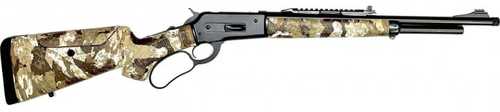
Taylor's & Company 1886 Journey Lever Action Rifle .45-70 Government 19" Barrel 5 Round Capacity Camouflage Syntheitc Stock Black Cerakote Finish
The 1886 Journey rifle is a great hunting trip companion. This rifle is chambered in the reliable .45-70 caliber. It features a black cerakoted receiver and parts, larger loop lever, synthetic camo stock and forend, threaded barrel, integrated picatinny rail rear sight, fiber optic front sight, and swivels.
Brand: Taylors & Company
Category: Rifles
Series: Journey
Model: 1886
Caliber: 45-70 Gov
Barrel Length Range: 19" to 19.99"
Stock Finish Group: Digital Camouflage
Capacity: 5+1
Stock Material: Synthetic
Action: Lever
Oal: 37.44"
Hand: Right
Sights: Fiber Optic Front, Peep Rear
Barrel Finish: Black Cerakote
Muzzle: Threaded
Twist: 1:18"
Application: Field
Safety: Tang
Stock Description: Adjustable Cheekrest
Barrel Length: 19"
Max Capacity: 5
Receiver Finish: Black Cerakote
Weight: 7.71 lbs
Caliber Dictionary
The Below Information Has Been Provided From Our Gun Caliber Dictionary And Is Meant For Informational Purposes Only. It Is Not Intended to Describe The Unique Specifications For This Ammunition.
Developed by the U.S. government for the trapdoor Springfield, the 45-70 was introduced in 1873, thus among the oldest cartridges still in continuous production. In the hands of the U.S. Army this was the cartridge that really won the West! Although officially replaced as our service cartridge by the 30-40 Krag in 1892 the 45-70 saw service in Cuba and the Philippines. It had long since been a popular sporting cartridge--and remains so today. Using a .458-inch bullet in a rimmed 2.105-inch case, original loadings with 70 grains of blackpowder used a 500-grain bullet for infantry and 405 grains for cavalry. Today's factory loads with smokeless powder are mild due to potential use in the weak trapdoor Springfield action. Standard is a 405-grain bullet at 1330 feet per second, with 300 and 350-grain loads at higher velocity available. The 45-70 was and is widely chambered in single-shots and remains popular in large-frame lever actions from Browning/Winchester, Henry, and Marlin. — Craig Boddington