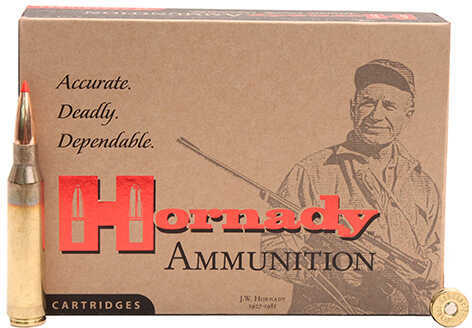
Hornady Match Ammunition is loaded to some of the most stringent specifications in the industry. These strict standards provide shooters with ammo that is guaranteed to have proper ignition and provide consistent, match-winning, pinpoint accuracy shot-after-shot. This ammunition will work as well or better than handloads. This ammunition is new production, non-corrosive, in boxer primed, reloadable brass cases.
The A-Max may be the most technologically advanced bullet ever designed. The aerodynamic secant ogive profile, sharp, pointed tip and unmatched concentricity give it an extremely high ballistic coefficient for near perfection in flight. After closely studying the performance of bullets for more than half a century, Hornady has incorporated every aspect of what makes a bullet accurate into the A-Max.
•Caliber: 338 Lapua Magnum
•Bullet Weight: 285 Grains
•Bullet Style: A-Max Boat Tail
•Case Type: Brass
Ballistics Information:
•Muzzle Velocity: 2745 fps
•Muzzle Energy: 4768 ft lb
•Ballistic Coefficient: .778
•Sectional Density: .356
•Test Barrel Length: 24"
Manufacturer: Hornady Model: 82301
Caliber Dictionary
The Below Information Has Been Provided From Our Gun Caliber Dictionary And Is Meant For Informational Purposes Only. It Is Not Intended to Describe The Unique Specifications For This Ammunition.
The 338 Lapua Magnum was developed in the 1980s in the United States with Finland's Lapua the initial manufacturer. It is based on the big, unbelted 416 Rigby case necked down to 338 with a case length of 2.724 inches. The intent was a long-range sniping cartridge that would fill the range gap between the 308 Winchester, then the standard, and the 50 BMG. Accurate and fast, with a 250-grain bullet at 3000 feet per second or a heavier, more aerodynamice 300-grain bullet at 2750 fps, it has been used successfully by numerous militaries in the Southwest Asia conflicts for long-range sniping, from 1500 yards to well beyond 2500 yards. As a hunting cartridge it is the most powerful of the 33-caliber cartridges, finding favor with today's increasing number of long-range specialists. Its only drawbacks are gun weight and recoil. — Craig Boddington