
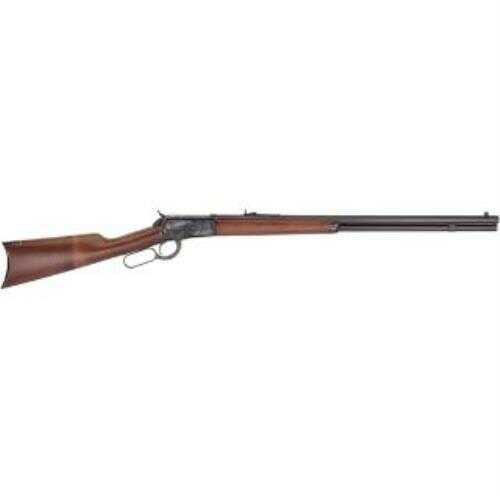
The 1892 Rifle was mechanically stronger and less costly to produce than the ’73. A total of 1,004,675 of the 1892s, in both solid and take-down models, were manufactured from 1892 to 1941. Taylor’s & Co. is proud to offer reproductions of these favorites. The rifles feature case-hardened frames and blue barrel finish.
Features: Octagonal barrel, blue finish with case hardened frame, straight walnut stock.
Specifications:
Barrel Length: 24" Octagonal
Caliber: .44-40
Capacity: 11
Weight: 7.3 lbs
Finish: Blue Finish with Case Hardened Frame
Grip/Stock: Walnut with Oil Finish
Manufacturer: Chiappa
Sights: Buckhorn Rear Sight, Blade Front Sight
Overall Length: 42.13"
Caliber Dictionary
The Below Information Has Been Provided From Our Gun Caliber Dictionary And Is Meant For Informational Purposes Only. It Is Not Intended to Describe The Unique Specifications For This Ammunition.
The 44-40 Winchester (44 WCF) was introduced by Winchester in 1873 in their Model 1873 lever action. The '73, "the gun that won the West," was the first truly successful repeater, and its 44-40 cartridge was quickly adopted by other manufacturers, including both Colt and Smith & Wesson in revolvers. Using a .427-inch bullet, the standard load features a 200-grain bullet at about 1100 feet per second, producing 588 foot-pounds of energy. This is not a lot of power, but the 44-40 was probaby the most popular sporting cartridge of the 19th Century, accounting for untold amounts of game. It remained the most popular chambering in the 1892 Winchester, and was a common chambering in both rifles and handguns at least through the 1940s. The growth in Cowboy Action shooting has revived it; the 44-40 has less recoil than the 45 Colt, and serves as a common chambering for rifles and revolvers. Ammo is readily available and it is chambered to numerous reissues and reproductions. — Craig Boddington