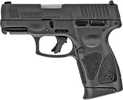
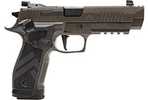
This Glock 19 Gen 4, in 9x19, introduces revolutionary design changes to the pistol that has found worldwide acclaim with security services both private and public. Its modular back strap design lets you instantly customize the grip to adapt to an individual shooter's hand size. The surface of the frame employs the new scientifically designed, real-world-tested, Gen 4 rough textured technology. Internally, the dual recoil spring assembly substantially increases the life of the system. A reversible enlarged magazine catch, changeable in seconds, accommodates left or right-handed operators. The Glock Modular Optic System (MOS) simplifies the mounting of popular optics without costly custom machining of the pistol's slide. MOS has four plate options to comply with the specifications of some of the most trusted optic manufacturers in the industry, and a cover plate when no optic is mounted. MOS gives you the option of adding tall iron sights allowing the optic and the iron sights to co-witness.
The Below Information Has Been Provided From Our Gun Caliber Dictionary And Is Meant For Informational Purposes Only. It Is Not Intended to Describe The Unique Specifications For This Ammunition.
The 9mm Luger (9X19mm, Parabellum, P08) was developed in Germany in 1902. Widely used in both world wars, it is the most popular pistol cartridge in the world, now widely used by innumerable law enforcement agencies and militaries (including our own) in both pistols and submachineguns. The controversy over its "stopping power" will never go away, but its attribute is that it is much easier to shoot accurately than larger cartridges with greater power...but more recoil. Advancements in bullet design for law enforcement and personal defense have narrowed the gap considerably. The 9mm Luger is a world standard, chambered by virtually all makers of semiautomatic pistols, with a myriad of factory loads. The most standard is probably a 115-grain load at 1160 fps, with common bullet weights ranging from 95 to 147 grains, and +P loads at higher velocity. — Craig Boddington