Taylors & Company Uberti Schofield Revolver 44 Russian 6.5" Barrel 6Rd Capacity Sights: Blade Front ...
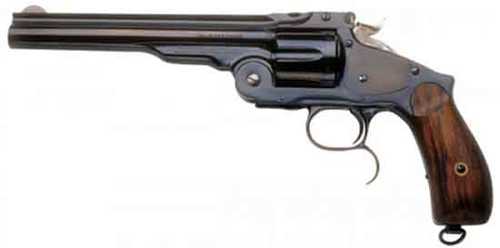
Taylors & Company Uberti Schofield Revolver 44 Russian 6.5" Barrel 6Rd Capacity Sights: Blade Front Rear On Back Of 2-Piece Walnut With Lanyard Ring Blued Finish
Taylor's & Company Uberti Schofield Revolver 44 Russian 6.5" Barrel 6Rd Capacity Sights: Blade Front, Rear Sight On Back Of Barrel 2-Piece Walnut With Lanyard Ring Blued Finish
The Russian was a favorite side arm of the Russian government and is the largest of the top-break revolvers. Modeled after the Smith & Wesson Schofield, this revolver features a hump-backed frame, two-piece walnut grips, lanyard ring, and triggerguard with a spur. The Russian barrel latch opens up and forward with a rear sight notch incorporated into it.
Caliber: .44RUSSIAN
Barrel Length: 6.5 Inch
Capacity: 6
Weight: 2.7 lbs
Finish: Blued
Grip/Stock: 2-piece Walnut with lanyard ring
Sights: Blade Front, Rear sight on back of barrel
Overall Length: 12.16 Inches
Caliber Dictionary
The Below Information Has Been Provided From Our Gun Caliber Dictionary And Is Meant For Informational Purposes Only. It Is Not Intended to Describe The Unique Specifications For This Ammunition.
The .44 Russian (.44 S&W Russian) was The .44 Russian, also known as the .44 S&W Russian, is a black-powder center-fire metallic revolver cartridge developed by Smith & Wesson in 1870, another of the very earliest centerfire cartridges. Legend has it that the .44 Russian was developed by Smith & Wesson following Grand Duke Alexis' legendary hunt with William F. Cody, and his admiration for Cody's S&W revolver (in the less powerful .44 S&W). Fact is Smith & Wesson developed a more powerful .44-caliber cartridge, and the Russian government placed a large order. Although the .44 Russian has a fairly short .9701-inch case, the .44 Russian is a powerful cartridge, propelling a heavy 246-grain bullet at 770 fps. The bullet diameter is .4323-inch. The .44 Russian was a major success for Smith & Wesson, with production continuing until 1940. — Craig Boddington