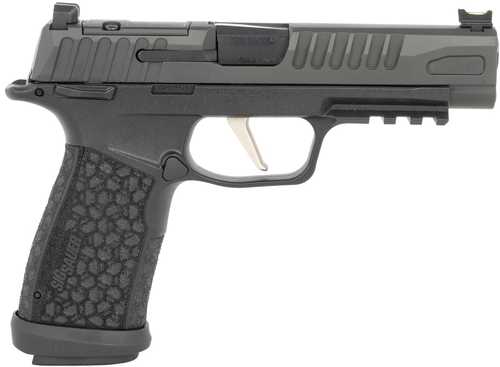
Sig Sauer P365 Fuse Compact 9mm Luger 17+1 4.30" Black DLC Barrel, Black Nitron Stainless Steel Optic Ready/Serrated Slide, Black Stainless Steel Frame w/Picatinny Rail, Black LXG Grip
Full-size capability and micro-compact concealment. The Fuse features a fiber optic front sight and black serrated rear sight; optic ready slide; LXG grip with laser engraved texture, Picatinny rail; flat faced trigger and interchangeable backstraps. Includes three backstraps.
Brand Sig Sauer
Category Pistols
Series Fuse
Model P365
Caliber 9mm Luger
Barrel Length Range 4" to 4.99"
Capacity 17+1
Action Striker Fire
Frame Finish Black
Oal 7.20"
Frame Material Stainless Steel
Slide Finish Black Nitron
Slide Material Stainless Steel
Sights Fiber Optic Front / Serrated Rear
Slide Description Optic Ready / Serrated
Barrel Finish Black DLC
Barrel Material Carbon Steel
Frame Size Compact
Grips Black LXG
Barrel Length 4.30"
Max Capacity 17
Trigger Flat Face
Frame Description Stainless Steel Frame w / Picatinny Rail
Caliber Dictionary
The Below Information Has Been Provided From Our Gun Caliber Dictionary And Is Meant For Informational Purposes Only. It Is Not Intended to Describe The Unique Specifications For This Ammunition.
The 9mm Luger (9X19mm, Parabellum, P08) was developed in Germany in 1902. Widely used in both world wars, it is the most popular pistol cartridge in the world, now widely used by innumerable law enforcement agencies and militaries (including our own) in both pistols and submachineguns. The controversy over its "stopping power" will never go away, but its attribute is that it is much easier to shoot accurately than larger cartridges with greater power...but more recoil. Advancements in bullet design for law enforcement and personal defense have narrowed the gap considerably. The 9mm Luger is a world standard, chambered by virtually all makers of semiautomatic pistols, with a myriad of factory loads. The most standard is probably a 115-grain load at 1160 fps, with common bullet weights ranging from 95 to 147 grains, and +P loads at higher velocity. — Craig Boddington