9mm Vs 5.56 NATO: Which Is Better For Your Survival Bug-Out Bag?

Hey there, fellow hunters and preppers! Jason Marsh here from Wholesale Hunter. If you’ve spent any time in the survival community, you know there’s one debate that never seems to die: "What should I pack in my bug-out bag?" Usually, that conversation dives head-first into the great caliber debate. Today, we’re looking at the two heavyweights: 9mm and 5.56 NATO.

Whether you're planning for a natural disaster or a total "SHTF" (Stuff Hits The Fan) scenario, your choice of caliber dictates more than just how much "oomph" you have; it dictates how far you can travel, how much weight you're hauling, and how well you can protect your family. Let’s break down which of these rounds deserves a spot in your pack.

The Weight Factor: Ounces Equal Pounds

When you’re "bugging out," you aren’t just driving to the range with a trunk full of gear. You’re likely on foot, or at least preparing for the possibility that your vehicle might become a 4,000-pound paperweight. In this world, ounces equal pounds, and pounds equal pain.

The 9mm Luger is the undisputed king of weight efficiency here. You can pack hundreds of rounds of 9mm ammo into a small space without feeling like you’re carrying a backpack full of bricks. On average, 500 rounds of 9mm weighs about 13 to 15 pounds. In contrast, 500 rounds of 5.56 NATO will tip the scales closer to 15-18 pounds depending on the grain.

Now, a couple of pounds might not seem like much when you’re standing in your living room, but try hiking ten miles uphill with it. That extra weight could have been an extra three days of food or a better medical kit.

Tactical tan bug-out bag packed with boxes of 9mm and 5.56 ammunition and survival gear on a wooden table.

Stopping Power vs. Effective Range

This is where the debate gets spicy. If you’re carrying a 9mm, you’re likely carrying a handgun or a Pistol Caliber Carbine (PCC). These are fantastic for close-quarters defense. If someone is 25 yards away and trying to do you harm, a solid 9mm like the Glock 19 Gen 5 is more than enough to handle the job.

However, survival isn't always about a shootout in an alleyway. Sometimes it’s about deterrence at a distance or even putting food on the table. This is where 5.56 NATO ammo shines. The 5.56 is a high-velocity rifle round designed to be effective out to 300 yards and beyond. If you see a threat coming from across a field, the 9mm is basically a paperweight, while the 5.56 gives you the reach to keep that threat far away.

Also, don't forget hunting. While neither is a "deer round" by traditional standards, a 5.56 rifle can take down small to medium game much more reliably than a 9mm handgun can.

The Platform: Handgun vs. Rifle

Your choice of caliber also dictates your firearm. A bug-out bag needs to be discrete. Carrying a full-sized AR-15 might make you a target or cause unnecessary panic in a semi-civilized evacuation.

If you go the 9mm route, you can carry a compact handgun and even a folding PCC like the Kel-Tec SUB2000. These can both fit inside your bag.

If you prefer the power of the rifle round but need it to stay compact, you might look at something like the Kel-Tec PLR-16 5.56 Pistol. It gives you rifle power in a much smaller package. And hey, if you already own one, don't forget to stock up on Kel Tec PLR 16 accessories to make it as ergonomic as possible for a long trek.

Compact 9mm handgun and folded survival carbine showing space-saving storage for emergency preparedness.

Logistics: The "Commonality" Rule

In a long-term survival situation, you might run out of what you brought. This is where the 9mm and 5.56 NATO both win over more "exotic" calibers. They are the two most common rounds in the United States. If you stumble upon a deserted hardware store or have to trade with another survivor, you’re much more likely to find 9mm or 5.56 than you are to find .357 SIG or .300 Blackout.

That said, I always tell people to keep a "plan B" in their home stash. For example, having a small revolver and some cheap .38 Special on hand is a great backup. It’s a simple, reliable system that anyone in the family can use if the main bug-out rifle goes down.

Versatility and Multi-Use

When we talk about bug-out bags, we usually focus on defense. But real survival is about staying fed and staying safe. While the 5.56 is more versatile for hunting, some people prefer a "multi-gun" approach.

I’ve seen guys pack a 9mm sidearm for defense and a small, lightweight shotgun for utility. If you’re looking at budget shotguns for your bag, a compact .410 can be a lifesaver. You can find 410 slugs for sale that turn a tiny squirrel gun into something capable of taking down a larger predator if things get hairy.

However, for most of us, carrying two or three different types of ammo is just too much weight. This is why the "caliber consolidation" rule is so popular: pick one and stick to it.

Tactical pouch with 9mm ammunition and red shotgun shells for wilderness survival in a forest setting.

The Case for the 9mm Bug-Out Bag

Pros:

  • Ammo Weight: You can carry a lot more.
  • Concealment: Handguns are easy to hide.
  • Ease of Use: Lower recoil, especially in a PCC.
  • Magazine Sharing: If your handgun and rifle use the same mags (like Glock mags), your life gets a lot simpler.

Cons:

  • Limited Range: Anything past 100 yards is a gamble.
  • Terminal Ballistics: It’s a handgun round; it doesn’t have the "shock" value of a high-velocity rifle round.

The Case for the 5.56 NATO Bug-Out Bag

Pros:

  • Reach: You can engage at several hundred yards.
  • Power: Much higher velocity and better penetration against barriers.
  • Versatility: Better for hunting medium game.

Cons:

  • Weight: Both the ammo and the rifles are generally heavier.
  • Noise: A 5.56 shot, especially from a short barrel, is deafening without ear pro.
  • Concealability: Even a "pistol" version of an AR is harder to hide than a 9mm.

Survival gear loadout featuring a 5.56 NATO rifle and 9mm sidearm with tactical accessories and flashlight.

Jason’s Expert Advice: Why Not Both?

If you ask me, the "perfect" setup isn't choosing one; it's balancing both. My personal bug-out setup involves a reliable 9mm sidearm like the Sig Sauer P320 and a compact 5.56 rifle.

Why? Because they serve different purposes. Your 9mm is your "get off me" gun: the one you use if someone surprises you. Your 5.56 rifle is your "leave me alone" gun: the one that ensures nobody gets close enough to surprise you in the first place.

If you’re on a tight budget and can only pick one, look at your environment. If you live in a dense urban area like Chicago or New York, the 9mm is probably your best bet. Most of your threats will be at close range, and concealment is key. If you live out in the plains or the mountains, you’d be crazy not to pick the 5.56 for its range.

Wrapping It Up

At the end of the day, the "best" caliber is the one you have practiced with. Don't just buy a box of ammo and throw it in a bag. Get out to the range, see how your bag feels while you're wearing it, and make sure your gear is up to the task.

Whether you need a new 9mm handgun, a budget-friendly survival rifle, or you’re just looking to stock up on bulk 5.56 ammo, we’ve got you covered here at Wholesale Hunter.

Stay safe, stay prepared, and as always: happy hunting!

  • Jason Marsh
    Owner, Wholesale Hunter

9mm Vs 5.56 NATO: Which Is Better for Your Home Defense Setup?

Hey there, folks! Jason Marsh here, owner of Wholesale Hunter. If there is one debate that has kept the lights on at gun shop counters and internet forums for the last three decades, it’s the battle between the 9mm and the 5.56 NATO.

When you’re looking to protect your home and your family, you want the best tool for the job. But "the best" is a subjective term in the firearms world. Are you looking for maximum stopping power? Are you worried about shooting through three walls and hitting the neighbor’s fridge? Or are you just looking for something that won’t jump out of your hands when you pull the trigger?

Today, we’re breaking down the 9mm vs. 5.56 NATO showdown specifically for home defense. We’ll look at the ballistics, the platforms, and the practical realities of a high-stress encounter in a hallway at 3:00 AM.

The Contenders: A Tale of Two Cartridges

Before we dive into the "which is better" part, let’s look at what we’re actually dealing with.

The 9mm Luger (9x19mm)

The 9mm is the undisputed king of handgun rounds. It’s been around since 1902, and thanks to modern metallurgy and ballistics technology, it’s more effective today than it’s ever been. It’s the standard for law enforcement and CCW holders for a reason: it offers a great balance of capacity, manageable recoil, and terminal performance. In a home defense scenario, you’re likely looking at a 9mm handgun like the Glock 19 or a Pistol Caliber Carbine (PCC).

The 5.56x45mm NATO

The 5.56 is the little brother to the .308, designed for the AR-15 platform to provide high velocity and light weight. It’s a rifle round through and through. While the bullet itself is actually smaller in diameter than a 9mm, it’s moving three to four times faster. That velocity creates a massive amount of kinetic energy and a phenomenon called hydrostatic shock.

Side-by-side comparison of 9mm and 5.56 NATO cartridges for home defense ballistics.

Stopping Power: Physics Doesn't Lie

When we talk about "stopping power," we’re talking about the ability of a round to neutralize a threat quickly.

The 5.56 NATO wins this round on paper every single time. A standard 55-grain 5.56 projectile is moving at roughly 3,000 feet per second (fps). A standard 115-grain 9mm projectile is moving at about 1,150 fps. Even though the 9mm is heavier, the 5.56 has significantly more muzzle energy because energy increases exponentially with velocity.

However, in a home defense situation, distances are usually under 7 yards. At that range, a well-placed shot with a quality 9mm hollow point is going to do the job. The 5.56 offers more "wiggle room" because of the trauma it causes to tissue, but it’s not like the 9mm is a peashooter.

The Over-Penetration Myth

One of the biggest concerns for homeowners is over-penetration. You don't want a bullet going through a bad guy, through the drywall, through the exterior siding, and into the house across the street.

Common sense tells you the "big powerful rifle" will go through more walls than the "small pistol." Interestingly, physics says otherwise.

Testing has shown that high-velocity, lightweight 5.56 rounds tend to fragment or tumble as soon as they hit a hard-ish surface like drywall. Because they are so light and moving so fast, they lose stability quickly. On the other hand, a 9mm bullet is heavier and more aerodynamic at lower speeds. It tends to hold its shape and "slug" its way through multiple layers of sheetrock.

If you are worried about your kids in the next room, a 5.56 with fragmenting home-defense loads might actually be safer than a 9mm FMJ. Of course, the best way to prevent over-penetration is to hit your target, which brings us to…

Maneuverability and Ease of Use

This is where the platform matters more than the caliber.

Handguns (9mm)

A handgun is small, easy to store in a bedside biometric safe, and allows you to keep one hand free to open doors, use a phone, or shepherd family members. However, handguns are notoriously difficult to shoot accurately under stress. They have a short sight radius and only two points of contact (your hands).

Rifles/Carbines (5.56 or 9mm)

An AR-15 or a PCC like the Ruger PC Carbine gives you three points of contact (hands and shoulder). This makes them much easier to aim and control, especially for shooters who aren't at the range every weekend.

If you like the idea of a rifle but want the 5.56's punch in a smaller package, people often look at "pistol" builds. If you go that route, don't forget to check out our Kel Tec PLR 16 accessories to get your setup dialed in.

Wholesale Hunter Logo

The Noise Factor

Have you ever fired a gun inside a small room without hearing protection? Don't. It’s deafening.

Both rounds are loud enough to cause permanent hearing damage instantly. However, the 5.56 has a much more violent muzzle blast, especially out of shorter barrels. The concussive force in a hallway can be disorienting for the shooter as well as the intruder. If you’re sensitive to recoil or muzzle blast, a 9mm PCC or a budget shotgun might be a more comfortable (if that's the right word) experience.

Training and Economics

At Wholesale Hunter, we’re all about value. You need to practice with what you protect with.

Currently, 9mm ammunition is generally cheaper than 5.56 NATO. This means you can afford to spend more time at the range. If you find yourself looking for other ways to save on practice, we occasionally have great deals on cheap 38 special for your revolvers or 410 slugs for sale for those who prefer a smaller gauge shotgun for home defense.

Firearms training setup at a shooting range with ammunition boxes and protective safety gear.

Comparison Table: 9mm vs. 5.56 NATO

Feature 9mm (Handgun/PCC) 5.56 NATO (AR-15)
Stopping Power Moderate High
Recoil Low to Moderate Very Low (in a rifle)
Capacity 15-33 rounds 30+ rounds
Maneuverability Excellent (Handgun) Moderate (Rifle)
Wall Penetration High risk with FMJ Moderate risk (tends to fragment)
Ease of Aiming Harder Easier

Which One Should You Choose?

Choose 9mm if:

  • You want a compact setup you can keep in a small safe.
  • You need to be able to operate the firearm one-handed.
  • You want to share magazines and ammo with your everyday carry (EDC) pistol.
  • You prefer a Pistol Caliber Carbine for its low recoil and "fun factor" at the range.

Choose 5.56 NATO if:

  • You want the best possible ballistic performance to end a threat.
  • You prefer the stability and accuracy of a rifle platform.
  • You want 30 rounds of firepower on tap without a reload.
  • You are concerned about over-penetration and plan to use fragmenting ammo.

Home defense setup with a 9mm handgun, 5.56 AR-15 rifle, and tactical flashlight on a nightstand.

Don't Forget the Basics

Regardless of which caliber you choose, a home defense gun needs a few "non-negotiables":

  1. A Weapon Mounted Light (WML): You cannot shoot what you cannot identify. Most home defense situations happen in the dark.
  2. Reliable Ammo: Don't use the cheapest steel-cased range junk for defense. Get high-quality defensive rounds.
  3. Training: A Smith & Wesson M&P15 in the closet is useless if you don't know how to clear a malfunction or reload in the dark.

Final Thoughts from Jason

Look, there is no "wrong" answer between 9mm and 5.56. Both have successfully defended homes for decades. If you’re a crack shot with a 9mm handgun but struggle to handle the length of an AR-15, stick with the 9mm. If you feel more confident with the "point and click" ease of a red-dot equipped rifle, go with the 5.56.

At the end of the day, the best home defense setup is the one you have practiced with until the controls are muscle memory.

Whether you need a new Glock 19, a rugged AR-15, or just a few boxes of target ammo to sharpen your skills, we’ve got you covered here at Wholesale Hunter.

Stay safe, stay prepared, and we'll see you at the range!

7 Mistakes You’re Making with Your Climbing Stand (and How to Fix Them)

If you’re a deer hunter, there is nothing quite like the freedom of a climbing stand. Unlike a heavy ladder stand or a permanent box blind, a climber lets you be mobile. You see fresh sign, you grab your stand, and you’re twenty feet up a tree before the sun even starts to peek over the horizon.

But as much as we love them, climbing stands are also responsible for a huge chunk of hunting-related accidents every year. Whether it’s a fall from height or just a stand that won't stop slipping, most of these issues come down to human error. At Wholesale Hunter, we want you to stay safe and stay successful. Jason Marsh here, and today we’re breaking down the seven most common mistakes hunters make with their climbing stands: and exactly how you can fix them before your next trip into the woods.

1. The "Leveling" Nightmare: Setting the Wrong Angle

This is easily the #1 mistake rookie (and even some veteran) hunters make. You get to the base of the tree, you set the platform perfectly level, and you start climbing. By the time you get to 20 feet, you’re sliding out of your seat because the platform is tilted downward at a 45-degree angle.

The Fix: Trees are not telephone poles; they taper as they go up. To have a level platform at your hunting height, you have to start with the stand angled upward at the base. It will look awkward and steep when you first step into it, but as the tree diameter gets smaller during your ascent, the stand will naturally level out.

Climbing tree stand angled upward at the base of a pine tree for proper leveling during ascent.

Before you go up, always ensure your teeth are biting in. If you're looking for gear to help organize your setup, check out our Outdoor Gear and Accessories to keep everything in order.

2. Choosing "The Forbidden Trees"

Not every tree is meant to be climbed. Many hunters find a great spot and try to force a climbing stand onto the nearest tree, regardless of the bark type. If you’re trying to climb a Hickory, an Ironwood, or a smooth-bark Maple, you’re asking for trouble. These hard-bark trees don't allow the stand’s metal teeth to "bite" in. Instead, the stand just skates across the surface.

The Fix: Look for "climber-friendly" trees. Pines, Oaks, and Poplars are generally excellent because the bark is soft enough for the teeth to engage but sturdy enough to hold your weight. Avoid trees that are too small (bending) or too large (the cable won't reach). If the tree is shedding bark like a lizard, move to a different one. Safety is more important than that specific shooting lane.

While you're scouting for the perfect tree, make sure you're carrying a reliable knife like the Outdoor Edge RazorLite for clearing small limbs or prepping your spot.

3. The "Ground-to-Canopy" Safety Gap

We see it all the time: a hunter puts on their harness, climbs to the top, and then clips into the tree. Statistics show that most falls happen while the hunter is actually climbing up or down, not while they are sitting still. If you aren't attached to the tree from the moment your feet leave the dirt, you aren't truly safe.

The Fix: Use a "Lifeline" or a tree strap that moves with you. You should attach your safety harness tether to the tree at ground level. As you move your climbing seat up, you slide your safety tether up. This way, if the platform slips or a cable gives way, you’re already caught.

Never hunt without a full-body harness. It’s the single most important piece of gear you own. If you need a fresh set of eyes to spot movement from your stand once you're safely up there, take a look at our selection of Binoculars.

Wholesale Hunter Logo

4. The "Free-Hanging" Platform Disaster

Most climbing stands come in two pieces: the seat section and the foot platform. A terrifying mistake hunters make is failing to lash these two pieces together with a connector strap. If you’re twenty feet up and your feet slip out of the stirrups, your foot platform can fall all the way to the base of the tree, leaving you dangling by your arms from the seat section.

The Fix: Always use a short length of rope or the manufacturer-provided "tether strap" to connect the top and bottom sections. It should be just long enough to allow you to take a full climbing step, but short enough that if the bottom falls, you can easily reach it with your feet to pull it back up.

Speaking of security, if you’re carrying a sidearm for protection while heading to your stand, ensure you have a quality holster that keeps it snug against your body during the climb.

5. Climbing with a Loaded Weapon (Don't Do This!)

It sounds like common sense, but every year people try to climb while wearing their rifle or bow on a shoulder sling. Not only is this cumbersome and throws off your balance, but it’s incredibly dangerous. A branch can snag your trigger, or a slip can send your firearm crashing into the ground: or worse, into you.

The Fix: Use a haul line. Tie one end to your stand and the other to your unloaded firearm or bow (left on the ground). Once you are safely at your hunting height and strapped in, pull your gear up. When you're ready to leave, lower it back down first. This keeps your hands free for the "three points of contact" rule while climbing.

If you’re looking for a great budget-friendly option for your next hunt, check out our deals on shotguns and remember to grab a pull-up rope while you’re at it!

Hunting rifle on the forest floor attached to a haul line for safe tree stand climbing.

6. Ignoring the Pre-Season Inspection

Your stand has been sitting in a damp garage or, worse, hanging on a tree in the backyard all off-season. Squirrels love to chew on seat cushions and straps. Moisture causes rust on bolts and weakens welds. If you don't inspect your gear, you’re trusting your life to a piece of equipment that might be one "pop" away from failure.

The Fix: Before the season starts, do a "nuts and bolts" check.

  • Check the cables or chains for fraying or rust.
  • Look at the welds for any hairline cracks.
  • Replace any nylon straps that show signs of UV rot or chewing.
  • Ensure the "teeth" are still sharp enough to grip.

If you find that your old stand is beyond repair, don't risk it. It’s cheaper to buy a new stand than it is to pay a hospital bill. While you're checking your gear, don't forget to stock up on essential ammunition like .38 Special or 9mm for your practice sessions.

7. Poor Weight Distribution and "The Wobble"

When you reach your height and transition from climbing to sitting, where you put your feet matters. Stepping on the very outer edge of a platform can cause it to "cam out" or shift suddenly, especially on trees with shaggy bark.

The Fix: Always keep your weight centered over the tree-side of the platform as much as possible when moving. When you finally stand up to take a shot, make sure your feet are planted firmly in the middle of the grate. If your stand feels "wobbly," it’s likely because you haven't locked the top and bottom sections tight against the tree using stabilizing straps (often called "third-hand straps"). These straps pull the seat and platform together once you're at height, making the stand feel as rock-solid as a permanent wooden blind.

Hunting boots centered on a metal climbing stand platform for stability and safety while hunting.

Bonus Tip: Silence is Golden

A climbing stand is a metal-on-metal machine. If you clank your way up the tree, every deer within half a mile knows you’re there. Use moleskin or "stealth strip" tape on any areas where the two sections might bang together during transport.

For those long hauls into the deep woods, you need a way to carry your water, extra layers, and snacks silently. A pack like the Tenzing TX 17 is designed specifically for hunters who need to stay organized without the extra noise.

Final Thoughts

Using a climbing stand is one of the most effective ways to hunt, but it demands respect. By fixing these seven common mistakes, you’re not just becoming a more successful hunter: you’re ensuring you make it home for dinner.

At Wholesale Hunter, we’re committed to getting you the best gear at the best prices. Whether you need new optics, reliable ammunition, or survival essentials, we’ve got your back.

Stay safe out there, keep your harness tight, and we’ll see you in the woods!

How to Choose the Best Shotgun Under $300.00 (Top Budget Performers Compared)

Hey there, fellow hunters and outdoor enthusiasts! Jason Marsh here from Wholesale Hunter. If you’ve been looking to add a reliable scattergun to your safe without emptying your wallet, you’ve come to the right place. There is a common myth in the firearms world that you have to drop a thousand bucks to get something that goes "boom" every time you pull the trigger. I’m here to tell you that’s just not true.

Whether you’re looking for a home defense tool, a reliable truck gun, or something to take out into the turkey woods, you can find some incredible performers for under $300.00. Today, we’re going to break down how to choose the right one and look at the top budget performers currently dominating the market.

The Reality of the Budget Shotgun Market

When we talk about "budget" shotguns, we aren’t talking about "cheap" in the sense of quality. We are talking about value. In the $200.00 to $300.00 range, you are typically looking at pump-action or single-shot models, though a few semi-autos occasionally sneak into the conversation.

The beauty of a shotgun in this price bracket is that it allows you to allocate more of your hard-earned cash toward things like ammunition, training, and survival gear. At Wholesale Hunter, we pride ourselves on finding those "sweet spot" deals that offer maximum performance for minimum investment.

Reliable matte black pump-action shotgun with shells on a workbench for budget-friendly home defense.

The Heavyweight Champion: Mossberg Maverick 88

If you ask anyone in the industry what the best shotgun under $300.00 is, nine out of ten people will immediately point to the Mossberg Maverick 88. It is, quite simply, the heavyweight champion of the budget world.

Usually priced between $200.00 and $250.00, the Maverick 88 is the younger, more affordable sibling of the legendary Mossberg 500. Here’s why it wins:

  1. Reliability: These are built in the same Eagle Pass, Texas factory as the Mossberg 500. They share many of the same internal parts and are designed to handle the same abuse.
  2. Interchangeability: One of the biggest selling points is that most Mossberg 500 barrels will fit right onto a Maverick 88. If you buy a 18.5-inch security model today, you can easily swap it for a 28-inch field barrel later for bird hunting.
  3. Simplicity: It features a cross-bolt safety on the trigger guard, which many shooters find more intuitive than the tang safety found on more expensive models.

You can often find the Maverick 88 and other similar pump-action workhorses in our firearms search section. It’s a gun that will likely outlive you if you give it even a modicum of care.

The Specialized Single-Shot: Savage 301

Sometimes, you don’t need five rounds. Sometimes, you just need one reliable shot in a lightweight, compact package. That’s where the Savage 301 comes in. Usually found well under $200.00, this single-shot break-action is the definition of a "truck gun."

It’s incredibly simple to operate, making it a great choice for beginners or as a dedicated turkey gun. In fact, Savage offers a "Turkey" version that is optimized for heavy loads and tight patterns. Because there are so few moving parts, there is very little that can go wrong. If you are looking for something to keep in the cabin or the back of the SUV for emergencies, this is a top-tier contender.

Tactical Value: The Citadel Warthog II

If you’re leaning more toward the home defense side of things, the Citadel Warthog II is a name you should know. Usually sitting around the $250.00 to $270.00 mark, this 12-gauge tactical shotgun offers features you usually only see on much pricier firearms.

It typically comes with a pistol grip and a more aggressive profile, making it easy to maneuver in tight spaces. While it doesn't have the decades of history that the Mossberg name carries, it has quickly gained a reputation for being a solid, functional semi-auto or pump option (depending on the specific configuration) for those on a strict budget.

Wholesale Hunter Logo

Key Considerations: Gauge and Capacity

When you’re browsing our current inventory, you’ll need to decide on the gauge.

  • 12 Gauge: The gold standard. It has the most stopping power and the widest variety of ammunition available. From birdshot to slugs, you can find 12-gauge shells anywhere.
  • 20 Gauge: A fantastic option for those who are recoil-sensitive or for younger shooters. It still packs plenty of punch for home defense or hunting but is much easier on the shoulder.
  • .410 Bore: Usually found in survival-style shotguns. It’s very low recoil but requires more precision and offers less "spread" than its larger cousins.

Comparison of 12-gauge, 20-gauge, and .410 bore shotgun shells for hunting and survival use.

Feeding Your Shotgun: Why Ammo Deals Matter

Buying the shotgun is just the first step. You need to feed it. At Wholesale Hunter, we’re always hunting for the best ammunition deals to pass along to you. While you’re picking up 00 buckshot for your new shotgun, don’t forget to check out our other deals.

For instance, we often have incredible prices on handgun ammo, like cheap .38 special for your revolvers. Maintaining a diverse stash of ammunition is a core part of any survival strategy. Whether it's 12-gauge shells or specialty rounds, we try to keep the costs down so you can practice more.

Upgrades and Survival Essentials

One of the best things about buying a budget shotgun like the Maverick 88 or the Winchester SXP is that you have money left over for accessories.

We are big fans of the Kel-Tec lineup for their innovative designs, and we often carry a range of Kel-Tec accessories and parts that can help round out your tactical kit. Beyond the gun itself, you should be looking at survival essentials:

  • A high-quality weapon light (essential for home defense).
  • A sturdy sling for carrying your firearm over long distances.
  • Extra shell holders or "side saddles" to keep more ammo on the gun.

If you’re looking for a specific model like the Savage Stevens 320 or perhaps a unique bullpup design, keep an eye on our daily updates. These budget-friendly options move fast because they offer so much utility for the price.

Tactical shotgun accessories including a weapon light, sling, and ammo for survival preparedness.

Jason’s Final Verdict

If I had $300.00 in my pocket and needed a shotgun today, I would go for the Maverick 88 every single time. Its track record is simply unbeatable. However, if I wanted something more compact for a survival bag, I might look at a single-shot 20 gauge or a compact pump-action.

The most important thing isn't the price tag: it's the reliability and your familiarity with the firearm. Get your shotgun, head to the range, and burn through some bulk ammo.

At Wholesale Hunter, we’re here to help you get geared up without breaking the bank. From shotguns to survival gear and everything in between, we’ve got your back. Stay safe out there, and happy hunting!


Quick Links for Your Next Purchase:

The Ultimate Guide to Kel-Tec PLR-16 Accessories: Everything You Need to Succeed

If you own a Kel-Tec PLR-16, you already know it’s one of the most unique firearms on the market. It’s essentially a gas-operated, semi-automatic pistol chambered in 5.56 NATO, packed into a frame that feels like a "pocket AR." But let’s be honest: straight out of the box, the PLR-16 is a bit of a wild child. It’s loud, it’s got a kick that’ll surprise you, and that minimalist polymer look is just screaming for some personalization.

At Wholesale Hunter, we’re all about helping you get the most out of your gear without breaking the bank. Whether you’re using your PLR-16 for a fun day at the range, a truck gun, or a specialized survival tool, the right accessories can transform this "fire-breathing dragon" into a precision machine.

In this guide, we’re going to walk through the essential upgrades you need to truly succeed with the PLR-16. From taming that muzzle blast to finding the perfect optic, we’ve got you covered.

Why Customize Your PLR-16?

The PLR-16 (Pistol, Long Range) was designed to offer the ballistic advantages of the 5.56 cartridge in a compact, lightweight package. However, because it’s so light (under 4 lbs empty), it can be a handful to manage. The short barrel leads to a massive muzzle flash and a concussive blast that can be felt in your teeth.

Customizing your PLR-16 isn’t just about looking cool: it’s about functionality. By adding the right parts, you can:

  • Reduce felt recoil and muzzle rise.
  • Manage heat more effectively during long strings of fire.
  • Improve target acquisition speed with better sights.
  • Enhance ergonomics for a more natural grip and feel.

If you are looking to start your build, you can always browse our current inventory for the basics.

Wholesale Hunter Logo

1. Taming the Beast: Muzzle Devices

If you only do one upgrade to your Kel-Tec PLR-16, make it a muzzle brake or compensator. The PLR-16 comes standard with 1/2×28 threading, which is the same as most AR-15s. This means you have a massive world of aftermarket options available to you.

The factory barrel is 9.2 inches long. When you touch off a 5.56 round in a barrel that short, a lot of unburnt powder ignites outside the barrel. The result? A fireball that can rival a Hollywood movie set. A quality muzzle brake redirects those gases to the sides and upwards. This does two things: it pushes the nose of the gun down (compensating for muzzle rise) and pulls the gun forward (reducing felt recoil).

When shopping for a muzzle device, look for something specifically designed for short-barreled rifles or pistols. Some popular choices include the Hera Arms Linear Compensator or similar blast-forwarding devices that push the noise away from the shooter.

Precision steel muzzle brake installed on a Kel-Tec PLR-16 for recoil management.

2. Handguards and Forend Upgrades

The standard PLR-16 comes with a very basic polymer forend that leaves the barrel exposed. Not only does this look a bit "naked," but it also means the barrel gets hot: fast. If you plan on shooting more than a magazine at a time, you’re going to want some protection for your support hand.

The Kel-Tec Compact Forend is a popular factory upgrade. It’s made of the same high-impact polymer as the grip and receiver, providing a comfortable place to hold the gun while adding Picatinny rails for accessories.

If you want to go the extra mile, look for aftermarket M-LOK or quad rail systems. These allow you to mount lights, lasers, and hand stops. Just a quick reminder on the legal side: adding a vertical forward grip to a pistol like the PLR-16 can change its legal classification under the NFA (National Firearms Act), so always check your local and federal laws before installing one. A hand stop or angled foregrip is usually the safer bet for a pistol build.

3. Optics: Seeing is Believing

The PLR-16 features a built-in Picatinny rail on the top of the receiver, which is practically begging for a red dot sight. While the factory iron sights are functional, they have a very short sight radius, making precision shots at distance a challenge.

A compact red dot is the way to go. You want something lightweight to match the gun's profile. A micro red dot from brands like Holosun or Sig Sauer provides quick target acquisition and a clear point of aim, even in low-light conditions.

One pro tip: the rail on the PLR-16 is a bit low. Many shooters find that adding a 1-inch Picatinny riser helps get the optic up to eye level, especially if you are using a cheek weld on the rear of the receiver. If you're looking for something rugged and reliable, check out these optics options we currently have in stock.

Compact red dot sight and Picatinny riser mounted on a Kel-Tec PLR-16 pistol.

4. Charging Handle Upgrades

The factory charging handle on the PLR-16 is a bit on the small side. If you’re under stress or wearing gloves, it can be difficult to manipulate. An oversized or tactical charging handle is a cheap and easy upgrade that makes a world of difference.

A larger handle gives you more leverage and a more positive surface to grab when racking the bolt. This is particularly useful if you have a large optic mounted that partially hangs over the charging handle area.

5. Magazines and Reliability

One of the best features of the Kel-Tec PLR-16 is that it takes standard AR-15/M16 magazines. This means you can use everything from 10-rounders for bench shooting to 30-round PMAGs for everything else.

While the gun usually ships with a 10-round magazine, we highly recommend picking up several 30-round Magpul PMAGs. They are the gold standard for reliability and fit perfectly in the PLR-16 mag well. If you’re feeling spicy, the PLR-16 even handles drum mags quite well, though it does make the gun significantly heavier.

For those looking for high-quality, reliable feeding, check out our magazine selection here.

6. Stability and Slings

Since the PLR-16 is a pistol, it doesn't come with a stock. To gain more stability, many shooters utilize a single-point sling. By pushing the gun forward against the tension of the sling, you create a "tension bridge" that helps steady your aim and manage recoil.

Kel-Tec offers a specific sling kit for the PLR-16, but any high-quality single-point sling will work. It’s an essential accessory for weapon retention and carrying the firearm if you're on the move in a survival or hiking scenario.

7. The Ammo Factor: Feeding the Dragon

The PLR-16 is chambered in 5.56 NATO, but it can also safely fire .223 Remington. Because of the short barrel, you’ll want to choose your ammo wisely. Heavier projectiles (62-grain and up) often perform better in short-barreled platforms, but standard 55-grain FMJ is great for general practice.

If you’re looking to stock up for your next range trip, we’ve got some great deals on 5.56 and .223 ammo. Keeping a good supply on hand is the first rule of being a responsible owner.

Brass 5.56 NATO cartridges and a 30-round magazine for a Kel-Tec PLR-16.

8. Maintenance and Takedown Pins

To keep your PLR-16 running smoothly, maintenance is key. One small but impactful upgrade is a set of extended takedown pins. The factory pins can sometimes be a bit stiff, requiring a tool to push them through. Extended pins allow for tool-less disassembly in the field, which is a huge plus if you need to perform a quick cleaning or inspection.

Don't forget to keep your action lubricated. Because the PLR-16 uses a long-stroke gas piston system (similar to an AK-47), it’s generally very reliable, but a little high-quality gun oil goes a long way. You can find cleaning kits and lube here to keep your gear in top shape.

Final Thoughts from Jason

At the end of the day, the Kel-Tec PLR-16 is a platform that rewards creativity. It’s a versatile, powerful, and frankly, fun-as-heck gun to shoot. Whether you’re turning it into a tactical beast with rails and optics or keeping it light and fast with a simple sling and muzzle brake, the goal is to make it work for you.

We’ve seen some incredible PLR-16 builds over the years, and we love seeing how our customers customize their gear. If you’re looking for more parts or just need some advice on what fits, don't hesitate to reach out or check out our full catalog of sporting goods.

Stay safe, shoot straight, and we’ll see you out there.

Wholesale Hunter Outdoor & Hunting

Top 10 Kel-Tec PLR 16 Accessories to Maximize Your Tactical Build

Hey there, fellow shooters! Jason Marsh here, owner of Wholesale Hunter. If you’ve ever handled a Kel-Tec PLR-16, you know exactly why it’s one of the most unique firearms on the market. It’s a gas-operated, semi-automatic pistol chambered in 5.56 NATO that essentially feels like a miniaturized AR-15 with a personality all its own. It’s loud, it’s flashy, and it’s an absolute blast to shoot at the range.

But here’s the thing: out of the box, the PLR-16 is a bit of a "blank canvas." While it’s functional and reliable, Kel-Tec designed it to be lightweight and affordable, which means there is a lot of room for improvement. If you want to turn this "hand cannon" into a truly capable tactical tool, you’re going to want to look at some upgrades.

Today, I’m breaking down the top 10 accessories to maximize your tactical build. Whether you’re looking to improve ergonomics, manage that legendary muzzle blast, or just make it look cooler, we’ve got you covered.

Wholesale Hunter Logo

1. The Aluminum Compact Forend

The most glaring omission on a stock PLR-16 is a proper handguard. From the factory, the barrel is exposed. Not only does this make the gun look a bit unfinished, but it also means you have very little real estate to hold onto once that barrel starts heating up: and trust me, it heats up fast.

Upgrading to a compact aluminum forend is the single best move you can make. It provides a heat shield for your hands and gives you a much more stable grip. Most aftermarket forends also come with Picatinny or M-LOK slots, allowing you to mount lights or lasers. It changes the silhouette of the gun from a "strange pistol" to a "tactical powerhouse."

2. A High-Quality Muzzle Brake

The PLR-16 has a 9.2-inch barrel. When you fire a 5.56 NATO round out of a barrel that short, two things happen: a massive fireball and a significant amount of muzzle flip. Fortunately, the barrel comes threaded (1/2×28), which is the standard for most AR-15 muzzle devices.

A dedicated muzzle brake or compensator is essential for staying on target during rapid fire. It redirects those gases to keep the nose down and helps tame the concussive blast that can sometimes be distracting for the shooter. Plus, let’s be honest, a rugged muzzle brake just looks right on a tactical build.

Tactical muzzle brake installed on a Kel-Tec PLR-16 threaded barrel at an outdoor shooting range.

3. Red Dot Optics

While the PLR-16 comes with basic iron sights, the sight radius is relatively short. To truly unlock the accuracy potential of the 5.56 round in this platform, you need a red dot. Because the PLR-16 has a built-in Picatinny rail on top of the receiver, mounting an optic is incredibly easy.

For a tactical build, I recommend something compact and rugged. You don’t need a massive scope; a simple 2-MOA red dot allows for lightning-fast target acquisition. If you’re looking for a variety of options, you can check out our current selection of optics and sights here to find the perfect fit for your budget.

4. Enhanced Takedown Pins

If you’ve ever tried to field strip a PLR-16 for cleaning, you know that the factory pins can be a bit of a pain. They often require a tool (or a very strong fingernail) to push through.

Enhanced or "tool-less" takedown pins are a small but mighty upgrade. These pins usually feature a larger, textured head that allows you to pull them out with your fingers. It makes maintenance at the range or on the workbench much faster. While you're at it, keeping a high-quality cleaning kit in your range bag is always a smart move to keep those internals running smoothly.

5. Tactical Sling and Rear Sling Mount

Because the PLR-16 is a large pistol, it can get heavy during a long day at the range or in a survival situation. Carrying it by hand 100% of the time isn't ideal. Adding a rear sling mount: usually a simple bolt-on piece at the rear of the receiver: allows you to attach a single-point or two-point sling.

A single-point sling is particularly popular for this build because it allows the gun to hang centrally on your chest, ready for action. It provides tension that can actually help stabilize your shots, acting as a sort of "third point of contact" against your body.

6. Extended Charging Handle

The stock charging handle on the PLR-16 is functional, but it’s a bit slim. If you’re wearing gloves or if you’ve mounted a large optic that hangs over the side of the receiver, grabbing that handle can become a chore.

An extended or "deflecting" charging handle gives you more surface area to grab onto. Some models are also designed to deflect spent brass further away from the shooter, which is a nice secondary benefit. It’s all about positive control: when you need to rack the bolt, you want to hit it right the first time without slipping.

Upgraded extended charging handle on a Kel-Tec PLR-16 being operated by a tactical gloved hand.

7. Backup Iron Sights (BUIS)

Electronics can fail. Batteries die, and glass can break. If you’re building this gun for "serious" use, you need a backup plan. A set of flip-up iron sights is the gold standard for any tactical build.

The Magpul MBUS Front Sight is a classic choice for a reason: it’s durable, lightweight, and stays out of the way until you need it. Since the PLR-16 has a full-length top rail, you have plenty of room to mount these alongside your primary red dot.

8. Pistol Stabilizing Brace

(Note: Always check your local and federal regulations regarding pistol braces, as laws can change.)

If you want to maximize the "tactical" part of your tactical build, an arm brace is a game-changer. It provides significantly more stability than shooting with two hands alone. Many adapters allow you to attach standard AR-style brace options to the rear of the PLR-16. This upgrade turns the PLR-16 from a "novelty" into a highly capable PDW (Personal Defense Weapon) style firearm.

9. Quad Rail Upgrades

If the standard compact forend isn't enough for you, a full quad rail system is the way to go. This gives you rails at the 3, 6, and 9 o'clock positions. Why would you want this? Because "tactical" often means "versatile."

With a quad rail, you can mount a tactical light at the 3 o'clock position, a laser at the 9, and perhaps a hand stop or angled foregrip at the 6 o'clock position. It gives you the ability to customize the ergonomics of the gun to your specific hand size and shooting style.

10. Reliable Magazines and Bulk Ammo

One of the best features of the PLR-16 is that it accepts standard AR-15/M16 magazines. However, not all mags are created equal. For a tactical build, you want something that is proven to feed reliably under pressure.

I always recommend keeping a healthy supply of 5.56 NATO or .223 ammunition on hand. The PLR-16 is hungry, and because it’s so fun to shoot, you’ll burn through a 30-round mag faster than you think. Stocking up on bulk ammo ensures that your range days aren't cut short by high prices or empty shelves.

Stacked 30-round magazines and 5.56 NATO ammunition ready for a Kel-Tec PLR-16 tactical range session.

Putting It All Together

Once you’ve added a few of these accessories, you’ll notice the PLR-16 feels like a completely different animal. It goes from being a light, somewhat jumpy pistol to a stable, controllable, and highly accurate platform.

Don't forget the small things, too. If you’re hauling your newly upgraded build to the range, you’re going to want a case that actually fits. A discrete soft case is perfect for the PLR-16’s compact dimensions, keeping your optics protected and your accessories organized.

At Wholesale Hunter, we love seeing how our customers customize their gear. The Kel-Tec PLR-16 is a testament to American ingenuity: it’s a simple design that invites you to make it your own. Whether you're a survivalist, a target shooter, or just someone who appreciates a well-made firearm, these top 10 accessories will help you get the most out of your Kel-Tec.

Safe shooting, and we'll see you out there!

: Jason Marsh
Owner, Wholesale Hunter

The Ultimate Guide to the Best Shotgun Under 300.00: Everything You Need to Succeed

Let’s be honest for a second: you don’t always need a high-end, custom-shop firearm to get the job done. Whether you’re looking for a reliable home defense tool, a rugged truck gun, or your very first hunting companion, the sub-$300 market is absolutely thriving right now. I’m Jason Marsh, and here at Wholesale Hunter, we see a lot of gear come through the doors. One of the most common questions I get is, "Jason, can I actually get a decent shotgun without spending half my mortgage?"

The answer is a resounding yes.

In this guide, we’re going to break down the heavy hitters in the budget shotgun world. We’re talking about the workhorses that offer the best bang for your buck, literally. We’ll look at the reliability of pump-actions, the modern value of budget semi-autos, and why sometimes a simple single-shot is all you need to succeed in the field.

Why the $300 Price Point is the Sweet Spot

There’s a misconception that "cheap" means "junk." In the world of modern manufacturing, that’s just not true anymore. Many of the shotguns we carry in our firearms inventory are built with the same fundamental designs that have been around for a century.

When you stay under $300, you aren’t paying for fancy engravings or high-grade walnut stocks. You’re paying for steel, polymer, and a firing pin that works. These guns are designed to be used, abused, and relied upon. They are the tools of the trade for people who value utility over aesthetics.

Wholesale Hunter Logo

The Undisputed Heavyweight: The Mossberg Maverick 88

If you ask any seasoned shooter what the best budget shotgun is, nine out of ten are going to say the Mossberg Maverick 88. Often referred to as the "King of Budget Pumps," the Maverick 88 is essentially the little brother to the legendary Mossberg 500.

The genius of the Maverick 88 lies in its simplicity. It features dual extractors, twin action bars, and a positive steel-to-steel lock-up. What does that mean for you? It means it cycles smoothly and reliably, even when things get dirty. Most importantly, it shares a huge amount of parts compatibility with the Mossberg 500, particularly the barrels. This means you can swap a 18.5-inch security barrel for a 28-inch field barrel in about thirty seconds.

Whether you are looking at a standard security model or a hunting configuration, the Maverick 88 consistently punches way above its weight class. It’s a gun you can buy today, use for twenty years, and then pass down to your kids.

The Tactical Value Contender: Stevens 320

If you want something that feels a bit more "tactical" right out of the box, the Stevens 320 (by Savage Arms) is a fantastic alternative. Often found with a pistol grip and ghost ring sights, the 320 is modeled after the Winchester 1300 design. It features a rotary bolt that is surprisingly fast to cycle.

The Stevens 320 is built like a tank. It’s a bit heavier than the Maverick, which actually helps with felt recoil: a big plus if you’re shooting 12-gauge buckshot. We often recommend this model for home defense because the ergonomics are intuitive, and the price point leaves you with plenty of extra cash to stock up on ammunition.

Black tactical pump-action shotgun for home defense with 12-gauge ammunition shells.

Semi-Auto Power on a Budget: GForce and Citadel

For a long time, the idea of a semi-automatic shotgun under $300 was considered a gamble. However, manufacturers like GForce Arms and Citadel have changed the game. Using proven gas-operating systems, these companies are producing shotguns that cycle reliably with standard loads.

The GForce GFBP Bullpup is a perfect example of modern innovation at a budget price. Bullpup designs move the action behind the trigger, making the overall length much shorter while keeping a full-length barrel. This makes it incredibly easy to maneuver in tight spaces like hallways or thick brush.

If you prefer a more traditional layout, the Citadel Warthog II offers semi-auto speed for about the price of a mid-range dinner out. While semi-autos in this price range can be "picky" with light target loads during the break-in period, once you run a few boxes of high-brass shells through them, they generally settle into very reliable shooters.

The Perfection of the Single Shot: Savage 301

Sometimes, you don’t need five rounds. Sometimes, you just need one shot that counts. The Savage 301 is a modern take on the classic break-action single shot. It is simple, safe, and incredibly lightweight.

Why would you choose a single-shot over a pump?

  1. Weight: They are incredibly easy to carry through the woods all day.
  2. Reliability: There is almost nothing that can go wrong mechanically.
  3. Focus: It’s the ultimate tool for teaching new shooters the importance of making every shot count.

The Savage 301 is especially popular among turkey hunters who want a compact platform for the spring woods. It’s proof that you can be successful in the field with a firearm that costs less than a pair of high-end hunting boots.

Choosing Your Gauge: 12, 20, or .410?

When you're shopping for a budget shotgun, you need to decide on the gauge.

  • 12 Gauge: The gold standard. It has the most variety of ammunition and the most stopping power. However, the recoil can be stout.
  • 20 Gauge: A fantastic "middle ground." It offers plenty of power for defense and hunting but with significantly less kick than the 12.
  • ** .410 Bore:** Great for small game and very low recoil, but the ammunition is surprisingly expensive compared to 12 or 20 gauge.

If this is your only shotgun, I’d almost always recommend starting with a 12-gauge 18.5" or 20" barrel model, like some of the tactical options here.

Wholesale Hunter Logo

Everything You Need to Succeed: Maintenance and Gear

Buying the gun is just the first step. To truly succeed with a budget shotgun, you need to maintain it and feed it. Because budget guns often use a "parkerized" or matte finish rather than high-polish bluing, they can be more susceptible to surface rust if left in a damp environment.

I always tell folks to pick up a decent cleaning kit and a can of quality oil. A quick wipe-down after a day at the range or a trip in the rain will keep that $250 shotgun running like a million bucks.

Shotgun cleaning kit with brass rod and gun oil for essential firearm maintenance.

Furthermore, consider your accessories. If you’re a fan of Kel-Tec platforms, we carry plenty of Kel-Tec specific upgrades that can enhance your shooting experience. For budget pumps, a simple shotgun sling and a stock-mounted shell holder are the most cost-effective ways to increase your efficiency.

Don't Forget the Ammo

A shotgun is just a heavy club without shells. One of the best ways to succeed with your new purchase is to practice often. At Wholesale Hunter, we pride ourselves on having deals that make sense for the high-volume shooter. While you're grabbing your new shotgun, don't forget to check our ammo deals. We’re always moving a lot of inventory, so whether you need 12-gauge buckshot or even a great price on cheap .38 special for your sidearm, we’ve got you covered.

Final Thoughts from Jason

At the end of the day, the "best" shotgun is the one you have with you when you need it. You don't need to be a millionaire to own a reliable, effective firearm. The models we’ve discussed: the Maverick 88, the Stevens 320, the GForce offerings: are all proof that the industry is listening to the needs of the everyday American.

Take the time to handle a few different models, see what fits your shoulder best, and then spend the money you saved on a few cases of shells and some targets. Proficiency comes from practice, not from the price tag on the box.

If you have questions about which budget shotgun is right for your specific needs, don't hesitate to reach out to us. We’re here to help you get geared up without breaking the bank. Happy shooting, stay safe, and we'll see you out there!

How to Choose the Best Shotgun Under $300 (Top Budget Models Compared)

Hey there, Jason Marsh here, owner of Wholesale Hunter. If you’ve been hanging around our shop or browsing the site lately, you know that prices on just about everything are going up. But here’s the good news: you don’t need to drop a month's rent to get a reliable, high-quality shotgun. Whether you're looking for home defense, a "truck gun," or something to take into the turkey woods, there are some incredible options sitting right under that $300 mark.

In this guide, I’m going to break down how to choose the right budget scattergun and compare the top models we see moving through our warehouse. We’re talking about real-world performance, not just spec sheets. Let’s dive in.

Why a Budget Shotgun?

A lot of guys think if they aren't spending $800 on a name-brand semi-auto, they’re getting "junk." That simply isn't true anymore. Modern manufacturing has gotten so efficient that entry-level pump-action shotguns are more reliable than ever. A $250 pump gun will go bang every single time you pull the trigger, provided you keep it clean and feed it decent shells.

When you save money on the firearm, you have more left over for the things that actually matter: training ammo, a solid weapon light, and maybe even a survival kit for your bug-out bag.

Key Factors to Consider Before Buying

Before we look at the specific models, you need to decide what you’re actually using this for. A 28-inch barrel is great for ducks but a nightmare for clearing a hallway in the middle of the night.

1. The Action Type

At the sub-$300 price point, you are primarily looking at Pump-Action and Single-Shot firearms.

  • Pump-Action: These are the kings of the budget world. They are manually operated, which makes them incredibly reliable. They aren’t picky about low-recoil shells, and they offer a 4-to-7-round capacity.
  • Single-Shot: These are the most affordable and often the most rugged. They are great for beginners, hikers, or as a dedicated turkey gun.

2. Gauge (12 vs. 20 vs. .410)

  • 12-Gauge: The gold standard. Ammo is everywhere, and it has the most stopping power.
  • 20-Gauge: A bit less kick, making it great for smaller-framed shooters or long days in the field.
  • ** .410 Bore:** Very light recoil, but the ammo can be pricier. Excellent for small game.

3. Barrel Length and Chokes

For home defense, you want an 18.5-inch to 20-inch barrel for maneuverability. For hunting, you’ll want something 24 inches or longer with interchangeable chokes so you can tighten your pattern.

Wholesale Hunter Logo

Top Budget Models Compared

We’ve tested a lot of glass and steel over the years. Here are the models that consistently earn their keep.

Model Type Approx Price Best For
Maverick 88 Security Pump $240–$270 Home Defense / Reliability
Stevens 320 Security Pump $190–$220 Features on a Budget
Savage 301 Turkey Single Shot $170–$200 Dedicated Hunting
Citadel CDP-12 Pump $150–$180 The Ultimate Value
Black Aces Tactical Pro Series S Semi-Auto $280–$300 High-Speed Tactical

1. The King: Mossberg Maverick 88

If I could only recommend one shotgun to someone on a budget, it’s the Maverick 88. Manufactured by Mossberg in Eagle Pass, Texas, this is essentially the "working man’s" version of the legendary Mossberg 500. It shares almost all the same internal parts, meaning you get the same dual-extractor and twin-action bar reliability.

The main difference is the cross-bolt safety (instead of the tang safety) and the forend which is pinned rather than using a slide tube. It’s a tank. You can find the Maverick 88 Security model with an 18.5-inch barrel that is perfect for home defense.

2. The Tactical Value: Stevens 320

Owned by Savage Arms, the Stevens 320 is an imported pump that clones the Winchester 1300 design. It features a rotary bolt that is surprisingly smooth for the price. What I love about the 320 is that it often comes with "premium" features like a pistol grip stock and ghost ring sights for well under $250. It’s a great option if you want a more tactical feel without buying aftermarket parts.

Tactical pump-action shotgun with pistol grip and ghost ring sights on a wooden workbench.

3. The Specialist: Savage 301 Turkey

If you aren't worried about magazine capacity and just want a lightweight, effective hunting tool, the Savage 301 is a winner. It’s a single-shot, break-action shotgun that comes optimized for turkey hunting right out of the box. It even includes an extra-full choke. In .410 or 20-gauge, it’s a featherweight choice for the survivalist who needs to put food on the table without carrying an 8-pound beast.

4. The Entry-Level: Citadel CDP-12

The Citadel CDP-12 is often one of the lowest-priced pump shotguns on our site. Don't let the price fool you; it’s a straightforward, functional firearm. It’s lightweight and usually comes with a synthetic stock that can take a beating. It’s the perfect "truck gun", something you aren't afraid to get a little dirty or scratched up while it sits behind the seat.

Survival Essentials and Upgrades

Choosing the shotgun is just step one. If you’re building out a survival kit or a home defense setup, you need to think about the ecosystem.

Stocking Up on Ammo

A shotgun is just a club without shells. While you're grabbing a new scattergun, don't forget to check our current deals on bulk ammunition. We’re also seeing a lot of guys looking for handgun practice rounds lately, if you need some cheap .38 special ammo for your revolver or even 9mm training rounds, we’ve got those in stock and ready to ship.

Accessories and Customization

If you’re into the tactical side of things, you might already own a Kel-Tec Sub-2000 or a KSG. We carry a wide variety of Kel-Tec accessories to help you customize your kit. For your budget shotgun, I highly recommend adding a side saddle to keep extra shells on the receiver. You don't want to be fumbling in your pockets when things go bump in the night.

Wholesale Hunter Outdoor & Hunting

Maintenance: Keep It Running

Budget shotguns are tough, but they aren't magic. To keep that Maverick 88 or Stevens 320 running for decades, you need a basic cleaning kit. A quick wipe-down with some CLP after a trip to the range goes a long way.

Cleaning a pump-action shotgun with a microfiber cloth and gun oil on a maintenance mat.

Final Thoughts: Which One Should You Buy?

If you want the most proven, American-assembled shotgun with the best aftermarket support: Go with the Maverick 88.

If you want the best tactical features (pistol grip, sights) for the lowest price: Go with the Stevens 320.

If you are a hiker or hunter looking for a simple, lightweight tool: Go with the Savage 301.

At the end of the day, any of these models will serve you well if you take the time to practice with them. Shotguns are versatile tools, they can defend your home, hunt your dinner, and provide a fun afternoon at the range.

Ready to make your choice? Head over to our firearms section to see what we have in stock today. And hey, while you’re there, check out these deals on storage cases to keep your new investment safe.

Stay safe and happy shooting!

: Jason Marsh
Owner, Wholesale Hunter

The Ultimate Guide to .410 Slugs: Everything You Need to Succeed

Hey folks, Jason Marsh here from Wholesale Hunter. If you’ve been hanging around the shop or browsing our site lately, you might have noticed a bit of a resurgence in the world of the "mighty" .410. For a long time, the .410 was looked at as just a "kid’s gun" or something you’d only use to knock a squirrel off a branch. But let me tell you, things have changed.

The technology behind .410 slugs has come a long way, and more shooters are realizing that these little rounds punch way above their weight class when handled correctly. Whether you’re looking for a low-recoil deer solution, a home defense option, or just want to see what your survival rig can really do, this guide is for you. We’re going to dive deep into the world of .410 slugs so you can pick the right gear and hit your target every single time.

The .410 Identity Crisis: Bore vs. Gauge

Before we get into the nitty-gritty of the slugs themselves, let's clear one thing up. If you want to sound like a pro at the range, stop calling it a ".410 gauge." Technically, it’s a .410 bore.

In the shotgun world, "gauge" is determined by how many lead balls the size of the barrel’s diameter it takes to weigh one pound. If the .410 followed that rule, it would be about a 67 or 68 gauge. But because it’s so small, we just use its actual measurement in inches: .410.

Why does this matter? Because that small diameter means you’re firing a projectile that looks a lot more like a heavy rifle bullet than a traditional shotgun slug. A typical .410 slug weighs between 1/4 and 1/5 of an ounce (roughly 87 to 109 grains). Compare that to a 12-gauge slug that can weigh over 400 grains, and you see the difference. However, what the .410 lacks in mass, it makes up for in velocity and low recoil.

Comparison of a .410 slug shell and a 12-gauge shotgun shell side-by-side on a workbench showing size difference.

Slug Anatomy: Foster vs. Brenneke

When you’re shopping for .410 ammunition, you’re going to see two main types of slugs: the Foster and the Brenneke. Choosing the right one is the difference between a successful hunt and a long day of frustration.

The Foster Slug

The Foster slug is what most people think of as a "rifled slug." It has a hollow base and a heavy nose. The idea is that the weight at the front keeps it flying straight, much like a badminton birdie.

  • Pros: They usually have higher muzzle velocities and are great for target practice or small varmints.
  • Cons: Because they are hollow, they tend to flatten out or disintegrate when they hit something hard. They don't offer the deep penetration needed for larger game.
  • Best for: Practice and coyote-sized animals.

The Brenneke Slug

If you’re serious about hunting, the Brenneke Magnum .410 is the gold standard. Unlike the Foster, the Brenneke is a solid lead projectile. It usually has a wad attached to the back that stays with it during flight to provide stability.

  • Pros: Incredible penetration and weight retention. It doesn’t break apart when it hits bone.
  • Cons: Usually a bit more expensive than standard Foster slugs.
  • Best for: Whitetail deer and personal defense.

Hunting with the .410: Is it Enough for Deer?

This is the million-dollar question. Can you actually hunt deer with a .410 slug? The answer is a resounding yes, but with some big "ifs."

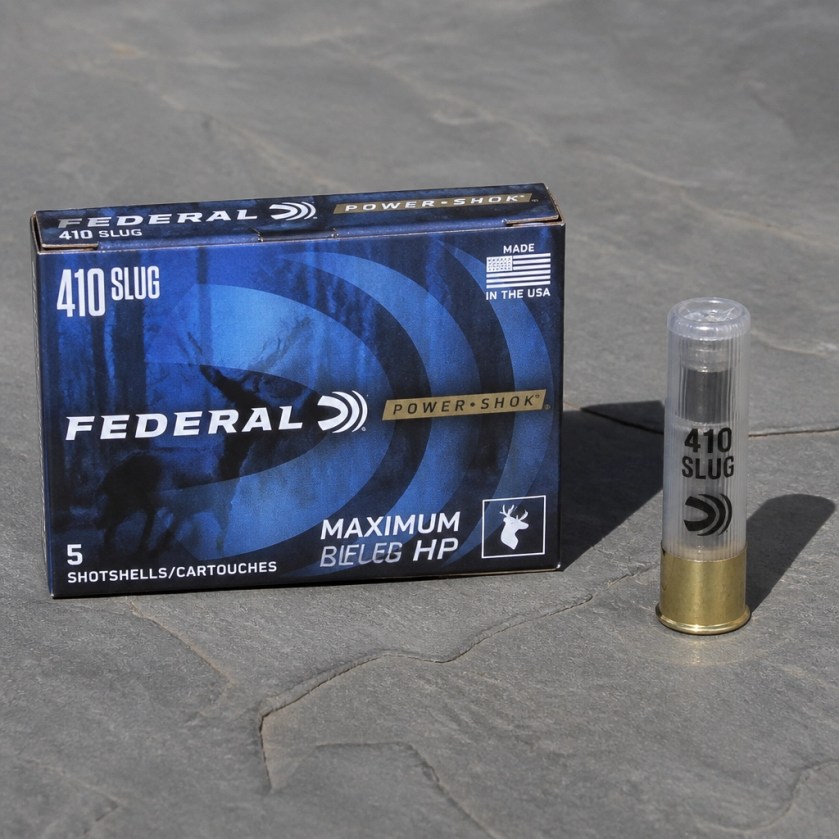
Back in the day, ethics-wise, many people frowned upon it. But with modern loads like the Federal Power-Shok .410 Slug, you’re getting muzzle velocities around 1,750 to 1,830 feet per second. That’s plenty of energy to humanely take down a whitetail.

However, you have to be a disciplined shooter. Your effective range is much shorter than a 12-gauge or a 30-06 rifle. Most experts recommend keeping your shots within 40 to 70 yards. Beyond 100 yards, the lightweight .410 slug loses velocity fast, and your accuracy will drop off. Think of it like bow hunting: you need to get close, be patient, and make sure your shot placement is perfect.

Whitetail buck in an autumnal forest viewed from the perspective of a .410 shotgun barrel during a hunt.

The Self-Defense Angle

Over the last decade, we've seen a massive surge in .410 handguns like the Taurus Judge and the S&W Governor. This has led to some incredible innovation in personal defense slugs.

If you’re using a .410 for home defense, you want something designed specifically for it. The Winchester PDX1 Defender is a legendary choice. It combines "Defense Disks" with plated BB shot, but if you prefer a straight slug, the Hornady Critical Defense .410 is hard to beat. It uses a unique "Triple Defense" load that includes a non-jacketed slug and two round balls.

The big advantage here is recoil. For shooters who might be recoil-sensitive: whether due to age, injury, or just personal preference: a .410 offers a manageable way to put a lot of stopping power downrange without the shoulder-bruising kick of a 12-gauge.

Maximizing Accuracy: Chokes and Sights

You can buy the best ammo in the world, but if your setup is wrong, you’re going to miss. Here are two things you need to get right:

1. The Right Choke

Most .410 shotguns come with a "Full" choke, which is great for squirrels but terrible for slugs. Squeezing a solid lead slug through a tight "Full" choke can deform the slug and ruin your accuracy.

  • The Sweet Spot: Use a Cylinder or Improved Cylinder choke. These allow the slug to exit the barrel without being constricted, leading to much tighter groups. If you need to upgrade your setup, check out our selection of choke tubes.

2. Sights Matter

Most bird guns just have a bead at the end of the barrel. That’s fine for a spread of birdshot, but it’s not precise enough for a single slug. If you’re serious about slug shooting, look for a shotgun with rifle sights or an optics rail. Even a simple red dot can transform a .410 into a tack-driver at 50 yards.

Compact .410 shotgun equipped with a red dot sight and sling resting on a canvas range bag at an outdoor range.

Survival and Budget Gear

One of my favorite things about the .410 is how affordable and portable the firearms can be. If you're looking for a "truck gun" or something to keep at the cabin, you don't have to spend a fortune.

The Rossi Tuffy is a classic example. It’s a break-action single shot that’s lightweight, rugged, and reliable. It’s the kind of gun you can throw in a pack and forget about until you need it. We also see a lot of folks looking for Kel-Tec accessories to trick out their KSG or survival rigs, many of which can be adapted for small-bore versatility.

Why We Love the .410 at Wholesale Hunter

At the end of the day, we’re all about getting people outdoors and making shooting accessible. The .410 is the ultimate "everyone" round. It’s perfect for teaching a youngster the ropes, it’s a blast for experienced shooters who want a challenge, and it’s a practical tool for survivalists.

We pride ourselves on keeping the gear you need in stock. Whether you're looking for cheap ammo deals or a new budget-friendly shotgun, we’ve got your back.

Final Tips for Success:

  1. Practice often: Because .410 has low recoil, you can spend hours at the range without getting fatigued.
  2. Test your ammo: Every shotgun is a little different. Buy a few different brands: maybe some Federal and some Brenneke: and see which one groups best in your gun.
  3. Keep it clean: .410 bores are small, and lead buildup can affect accuracy faster than in larger gauges. A quick scrub after each range session goes a long way.

Wholesale Hunter Logo

Thanks for stopping by the blog! If you have questions about which slug is right for your specific shotgun, don't hesitate to reach out or drop by the site. We’re always happy to help you find the right tool for the job.

Stay safe, shoot straight, and we’ll see you out there.

: Jason Marsh
Owner, Wholesale Hunter

The Ultimate Guide to 410 Slugs: Everything You Need to Succeed

Hey there, folks! Jason Marsh here from Wholesale Hunter. If you’ve spent any time in the woods or at the range, you’ve probably heard someone dismiss the .410 bore as a "kid's gun." Around here, we know better. While it might be the smallest common shotgun gauge on the market, when you load it up with the right slug, it becomes a precision tool that commands respect.

Whether you're a seasoned hunter looking for a challenge, a homesteader needing a versatile pest-control option, or just someone who loves the low recoil and high fun-factor of the .410, understanding how slugs work in this platform is essential. Today, we’re diving deep into the world of .410 slugs, from the science of the projectiles to the practical reality of taking one into the deer woods.

What Exactly is a .410 Slug?

Technically, the .410 is a "bore," not a "gauge." If it were measured like a 12-gauge (based on the weight of a lead ball), it would be something like a 67-gauge. Because it’s so slim, the slugs we use in it are unique.

A standard .410 slug is typically a "1/5 ounce" projectile. In the world of grains (the measurement most shooters are familiar with), that’s about 87.5 grains. To put that in perspective, a standard 9mm handgun round is usually 115 or 124 grains. However, the .410 slug makes up for its lighter weight with some serious velocity, often leaving the muzzle at over 1,800 feet per second (fps).

When you’re looking to stock up, you can find our full selection of .410 ammunition right here to see what's currently in the warehouse.

Foster vs. Brenneke: The Great Debate

When you start shopping for slugs, you’re going to run into two main designs: the Foster-style (or "American Rifled Slug") and the Brenneke. Understanding the difference is the biggest step toward success in the field.

The Foster Slug

This is the most common type you’ll find from big names like Winchester, Remington, and Federal. It has a hollow base and a heavy nose. The idea is that the weight forward keeps it flying straight, much like a badminton birdie. Most Foster slugs have "rifling" (little grooves) on the side. Contrary to popular belief, these don't make the slug spin; they are there to allow the slug to compress easily if it hits a tight choke.

The Brenneke Slug

Brenneke slugs are a different beast. They feature a solid lead head with a wad attached to the rear that stays with the slug in flight. In our experience, Brenneke slugs almost always offer better penetration and less deformation upon impact. If you are hunting something larger than a coyote, the Brenneke design is generally the way to go because it doesn't "pancake" as easily as the hollow-base Foster.

Side-by-side comparison of Foster and Brenneke .410 shotgun slugs on a workbench.

Ballistics: The Reality Check

Let’s talk numbers, because the math doesn't lie. A typical .410 slug produces about 640 to 700 foot-pounds of energy at the muzzle. By the time that slug travels 50 yards, that energy drops significantly.

Compare that to a 12-gauge slug, which can push over 2,400 foot-pounds of muzzle energy. It’s clear that the .410 is in a different weight class. This doesn't mean it isn't effective; it just means you have to be much more disciplined with your shots. It’s often compared to hunting with a .357 Magnum revolver or a high-end archery setup. You need to be close, and you need to be precise.

If you're looking for other types of ammo to compare or just need to grab some bulk practice rounds, check out our general ammunition deals.

Hunting with the .410: Limits and Ethics

Can you hunt deer with a .410 slug? In many states, yes (but always check your local regulations first!). However, just because you can doesn't mean you should take 150-yard shots across a bean field.

The 50-Yard Rule

For most shooters using a smoothbore barrel with beads or basic iron sights, 50 yards is the "golden circle." At this distance, the slug still has enough velocity to expand or penetrate effectively, and your accuracy is likely to stay within a 4-inch group. Some experts will push it to 100 yards with a rifled barrel and an optic, but for the average setup, 40 to 60 yards is the sweet spot for a clean, ethical kill.

Shot Placement

With a 12-gauge, you have a lot of "room for error" because of the massive kinetic energy. With a .410, you have none. You are looking for a perfect double-lung shot or a heart shot. Avoid the heavy shoulder bones of a large buck if you are using a softer Foster-style slug, as it might fail to penetrate through to the vitals.

A .410 bore shotgun resting against a mossy tree in a forest for deer hunting.

Choosing the Right Shotgun Setup

Not all .410s are created equal. The gun you use will dictate which slugs you should buy.

  1. Smoothbore Barrels: This is what 90% of .410 owners have. You’ll want to stick with "rifled" slugs (Foster or Brenneke).
  2. Rifled Barrels: These are rarer in .410 but they do exist. If you have a fully rifled barrel, you can use sabot slugs, which are encased in a plastic sleeve, for much better accuracy at distance.
  3. The Choke Factor: This is important. Never fire a slug through an "Extra Full" or "Turkey" choke. While most slugs are designed to swage down through a "Full" choke, it’s not ideal for accuracy and puts unnecessary stress on the barrel. An "Improved Cylinder" or "Modified" choke usually gives the best results for slug accuracy.

If you're looking for a dedicated slug gun or a versatile field piece, we often have great options like the Kel-Tec KSG7 or other compact models that handle these loads well.

Accessories and Preparation

To get the most out of your .410, you need more than just the ammo. Accuracy is a system. If your shotgun allows for it, mounting a small red dot or a low-power scope can shrink your groups significantly. Since the recoil is so light, you don't need a heavy-duty "shotgun rated" scope that costs a fortune.

Don't forget the basics either. A good cleaning kit is essential because lead slugs can leave significant fouling in those small bores, which will kill your accuracy after just a few shots. We also recommend keeping your gear organized in the field with a solid shotgun shell pouch or a stock-mounted shell holder.

Shooting accessories for .410 shotguns including a cleaning kit and slug shells.

A Word on Reloading .410 Slugs

For the DIY crowd, reloading .410 slugs is a great way to save money, especially since .410 is notoriously expensive compared to 12-gauge. However, it requires precision. Because the .410 operates at higher pressures than its larger cousins, you must follow your manual to the letter.

One tip from the pros: slug your barrel. Use a soft lead fishing sinker to measure the exact bore diameter of your shotgun. .410 barrels can vary from .404 to .411 inches. Knowing your exact diameter helps you choose or cast the right size slug for maximum accuracy. If you're looking for reloading supplies or scales, we have a variety of precision tools to help you get the job done right.

Why We Love the .410 Slug

At the end of the day, the .410 slug is about finesse. It’s for the hunter who prides himself on getting close. It’s for the shooter who wants to spend all day at the range without a bruised shoulder. And it’s for the homeowner who wants a manageable, effective round for property defense against pests or predators.

When you treat the .410 with the respect it deserves: choosing the right slug for the job and staying within your effective range: it’s a remarkably capable round.

If you're looking for more gear to round out your kit, whether it's protective cases for your shotgun or specialty tools, we’ve got you covered here at Wholesale Hunter.

Hands loading a .410 slug shell into a compact shotgun at a rural homestead.

Final Thoughts

The "Ultimate Guide" boils down to this: Know your gear, know your distance, and practice. Don't just buy a box of slugs and head into the woods. Take them to the range, see how they group out of your specific barrel and choke, and find the limit of your own accuracy.

The .410 might be small, but when that slug hits the mark, it’s all the gun you’ll ever need.

Stay safe out there, and happy shooting!

: Jason Marsh
Owner, Wholesale Hunter