Used 38 Special Secrets Revealed: How to Score a Reliable Revolver on a Budget

If you’ve been hanging around the shop or browsing the site lately, you’ve probably noticed that the world of firearms is getting more expensive. Whether it’s the latest high-tech polymer wonder-nine or a custom-built rifle, prices seem to be heading north. But here at Wholesale Hunter, we’re all about getting you the most bang for your buck.

One of the best ways to do that? Look into the world of used .38 Special revolvers.

I’m Jason Marsh, and I’ve seen a lot of guns come and go through our doors. There is something special about a classic wheelgun. They are simple, they are reliable, and if you know what to look for, you can find a used one that shoots better than most modern budget pistols. But you can't just buy the first shiny thing you see. You need to know the "secrets" of the used market to make sure you’re getting a tool, not a paperweight.

Why Go Used? The Value Proposition

You might be wondering, "Jason, why would I buy a 40-year-old Smith & Wesson when I can buy a brand-new budget revolver today?"

The answer is simple: Quality and craftsmanship. Back in the day, we’re talking the 1960s, 70s, and 80s, revolvers like the Smith & Wesson Model 10 or the Colt Official Police were built by craftsmen who spent hours fitting parts together. These guns often have tighter tolerances, better-quality steel, and trigger pulls that are smoother than silk compared to the mass-produced budget options hitting the shelves today.

Plus, you can often find military or police surplus revolvers. These guns usually have some holster wear (scratches on the outside), but they were often "carried much and fired little." This means you get a high-end firearm at a fraction of the cost.

And hey, if the price tag is still a bit high for your current budget, don't forget we offer Sezzle at checkout. It lets you buy now and pay later with interest-free installments. It’s a great way to secure that classic revolver before someone else grabs it.

Wholesale Hunter Logo

The Inspection Checklist: How Not to Get Burned

When you’re looking at a used .38 Special, you need to be a bit of a detective. You aren't just looking for rust; you’re looking for mechanical health. Here is my personal checklist for evaluating a used revolver.

1. The Barrel and Frame Junction

This is the "handshake" of the gun. Look where the barrel screws into the frame. They should be perfectly square. If you see a gap or if the barrel looks slightly tilted to one side, walk away. This usually indicates a structural issue or a botched repair job.

2. The Bore and Rifling

Always carry a small flashlight. Open the cylinder (make sure the gun is unloaded, obviously!) and shine the light through the barrel. You want to see sharp, crisp "mountains and valleys" (rifling). If the inside of the barrel looks smooth or "frosted," it’s worn out.

Most importantly, look for "rings" or bulges inside the barrel. These are caused by "squib loads": when a bullet gets stuck in the barrel and another one is fired behind it. A bulged barrel is a deal-breaker. It's unsafe and expensive to fix. If you want to learn more about different calibers and what to look for, check out our Caliber Dictionary.

3. The Forcing Cone

The forcing cone is the back end of the barrel where the bullet enters after jumping across the gap from the cylinder. Check this area for cracks or chips. If the forcing cone is split, the gun is essentially a decorative piece. It cannot be safely fired.

Inspecting the forcing cone of a used .38 Special revolver for cracks and structural damage.

4. Cylinder Timing and Lock-up

This is the most critical mechanical test. Each "chamber" in the cylinder needs to line up perfectly with the barrel when the hammer falls.

  • The Test: With the gun unloaded, slowly pull the hammer back (single action). You should hear a distinct "click" as the cylinder locks into place before the hammer reaches full cock.
  • The Lock-up: Once the hammer is back, hold it and try to wiggle the cylinder. A tiny bit of movement is normal for some brands, but it shouldn't feel loose or "sloppy."

5. Check for Frame Cracks

Look underneath the barrel and around the firing pin hole. Use your light to search for tiny hairline cracks. These are signs of metal fatigue. A cracked frame is not repairable and is extremely dangerous.

Red Flags: When to Walk Away

I love a good project, but some "deals" are just headaches in disguise. If you see any of the following, keep your money in your pocket:

  • Deep Pitting: Surface rust can often be cleaned, but deep pitting (holes in the metal) means the integrity of the steel is compromised.
  • Refusal to Dry Fire: If a seller won't let you test the trigger or the timing (even with snap caps), they might be hiding a mechanical flaw.
  • Home Gunsmithing: If the screws on the side plate look chewed up, someone who didn't know what they were doing has been inside the gun. This often leads to light primer strikes or unsafe triggers.

Feeding Your New (Old) Revolver

Once you’ve scored that reliable .38 Special, you’re going to want to shoot it. The beauty of the .38 Special is that it’s a joy to shoot: low recoil and very accurate.

At Wholesale Hunter, we want to make sure you can afford to practice. We offer bulk ammo discounts: you get 5% off when you buy 10 or more boxes of the same ammo. It’s the perfect way to stock up. You can find some of our latest deals on our Ammunition Page.

If you’re looking for the best deals specifically for this caliber, I highly recommend reading our guide on Finding the Best Cheap 38 Special Ammo in 2026. It breaks down which loads are best for target practice and which ones you should trust for home defense.

Bulk boxes of .38 Special ammunition and brass cartridges ready for target practice.

Making the Most of Your Purchase

We’re a family here at Wholesale Hunter, and we love hearing from our customers. Once you get your revolver out to the range, come back and leave a review on the gear you used. We offer a 5% discount for reviews! It’s our way of saying thanks for helping the rest of the community know what works and what doesn't.

And while you’re browsing for that perfect revolver, keep in mind that we offer Free Shipping on all long guns. So if you decide to pair that .38 Special with a new lever-action rifle or a shotgun, the shipping is on us!

Final Thoughts from Jason

Buying a used .38 Special is a rite of passage for many gun owners. It teaches you how to appreciate the mechanics of a firearm and gives you a piece of history that you can actually use. Whether you’re looking for a budget-friendly home defense option or just a fun range toy, a used revolver is a fantastic choice.

Just remember:

  1. Check the timing.
  2. Inspect the bore.
  3. Look for cracks.
  4. Use Sezzle if you need to spread out the cost.
  5. Buy your ammo in bulk to save.

If you have any questions about a specific model you see on our site, don't hesitate to reach out. We’re here to help you find exactly what you need without breaking the bank.

Happy hunting!

: Jason Marsh
Owner, Wholesale Hunter

Wholesale Hunter Logo


Ready to start your search? Check out our full inventory of firearms and accessories at WholesaleHunter.com. From ammunition boxes to cartridge belts, we’ve got you covered.

Kel-Tec PLR-16 Accessories: 7 Must-Have Upgrades for Accuracy and Control

So you picked up a Kel-Tec PLR-16 and you're looking to squeeze every bit of performance out of this quirky little pistol-caliber firearm. Smart move. The PLR-16 is a solid platform right out of the box, but with a few strategic upgrades, you can transform it from a fun plinker into a seriously accurate shooter.

Here's the thing: the PLR-16 wasn't designed to be perfect for everyone. It's a pistol that fires rifle ammo, which means there's some inherent quirks to manage. But that's where aftermarket accessories come in. Whether you're dealing with muzzle flip, struggling with target acquisition, or just want to make those extended range sessions more comfortable, these seven upgrades will make a real difference.

Let's dive into the must-have accessories that'll boost your accuracy and control without breaking the bank.

1. Red Dot Optic: The Single Biggest Game-Changer

If you're still using iron sights on your PLR-16, you're leaving a lot on the table. A quality red dot sight is hands-down the most impactful upgrade you can make.

Kel-Tec PLR-16 with red dot optic sight mounted for improved accuracy

The PLR-16's flat-top receiver is practically begging for an optic. You'll notice the difference immediately, faster target acquisition, better accuracy at distance, and way less eye strain during longer shooting sessions.

What to look for:

  • Brands like Holosun, Vortex, and Primary Arms offer solid options at different price points
  • Larger viewing windows help you get on target faster
  • Go for something with a durable mount since the PLR-16's recoil can be snappy

Don't overthink it. Even a budget-friendly red dot will be a massive upgrade over irons. And here's a pro tip: once you've got your optic dialed in, leave a review on Wholesale Hunter and score 5% off your next order. That discount can go toward stocking up on 5.56/.223 ammunition, more on that in a minute.

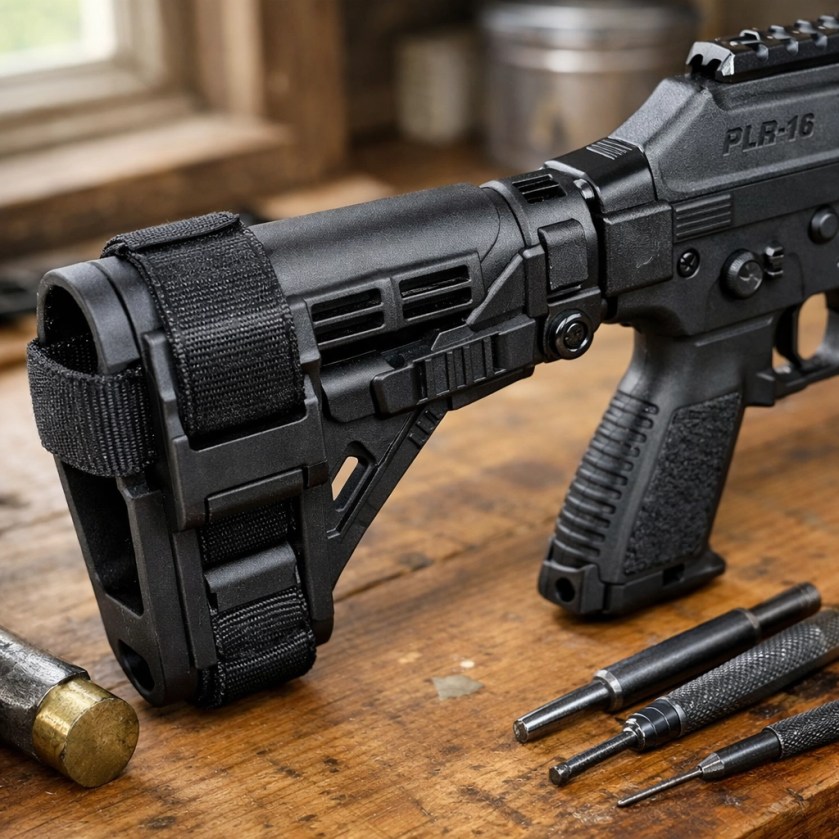
2. Arm Brace Adapter Kit: Legally Boost Your Accuracy

Since the PLR-16 is classified as a pistol, you can legally slap on a stabilizing brace. And trust me, you should.

An arm brace adapter kit completely changes the shooting experience. You'll see tighter groups, less fatigue, and way more confidence when taking shots beyond 25 yards. It's basically a cheat code for precision work or extended range sessions.

Why it matters:

  • Dramatically improves stability and control
  • Reduces felt recoil and muzzle rise
  • Makes the PLR-16 much more comfortable to shoot for longer periods
  • Takes about 15 minutes to install

If you're serious about wringing out every bit of accuracy from your PLR-16, this upgrade should be at the top of your list. Pair it with a good optic, and you'll be amazed at what this little pistol can do.

3. Compact Forend: Better Balance, Less Weight

The factory forend on the PLR-16 gets the job done, but it's not winning any awards for ergonomics or weight distribution. Swapping it out for a compact aftermarket option is one of those simple upgrades that makes a bigger difference than you'd expect.

Stabilizing arm brace adapter attached to Kel-Tec PLR-16 on workbench

A quality compact forend:

  • Shaves off unnecessary weight
  • Improves overall balance
  • Makes the gun feel more nimble
  • Especially helpful if you've got smaller hands

Installation is stupid simple, we're talking 10 minutes max with basic tools. The improved balance alone makes this upgrade worth it, but you'll also appreciate the better heat dissipation during rapid-fire sessions.

4. Muzzle Brake: Tame That Recoil

Let's be real: a 5.56 pistol is going to have some kick. It's just physics. But a good muzzle brake can make a noticeable difference in managing that recoil and keeping your sights on target for follow-up shots.

Benefits of a quality muzzle brake:

  • Reduces felt recoil significantly
  • Minimizes muzzle rise
  • Helps you stay on target during rapid fire
  • Makes the shooting experience more pleasant overall

Fair warning: muzzle brakes can be loud. Like, really loud. Your range buddies might not love you for it. But if accuracy and control are your priorities (and they should be), it's a trade-off worth making.

Looking to stock up on ammo to really test out your new brake? Grab 10 or more boxes of 5.56/.223 from Wholesale Hunter and automatically save 5% on bulk orders. That's the kind of deal that makes trigger time more affordable.

5. Quad Rail Handguard: Maximum Customization

Want to mount a light? How about a laser? Maybe a forward grip? A quad rail handguard gives you all the real estate you need to customize your PLR-16 exactly how you want it.

Kel-Tec PLR-16 quad rail handguard upgrade for accessory mounting

Brands like Midwest Industries make rock-solid quad rails that'll hold up to the PLR-16's firing characteristics. Once installed, you've got Picatinny rails on all four sides of the forend, which means endless accessory mounting options.

Popular additions include:

  • Tactical lights for low-light shooting
  • Laser aiming devices
  • Forward grips for better control
  • Bipods for bench shooting

The beauty of a quad rail is that you can experiment with different setups until you find what works best for your shooting style. And if you're on a budget (who isn't?), you can add accessories over time rather than all at once. Spread out those purchases and use Sezzle's buy now, pay later option to make it even easier on your wallet.

6. Deflecting Operating Handle: Smoother Operation

The factory charging handle on the PLR-16 works fine, but an upgraded deflecting operating handle improves ergonomics and makes the gun easier to manipulate: especially when you're wearing gloves or working under stress.

This might seem like a minor upgrade, but think about how many times you manipulate that charging handle during a shooting session. Every little bit of improved ergonomics adds up.

What you'll notice:

  • Easier to grip and pull
  • Better ergonomics overall
  • More positive engagement
  • Easier brass deflection away from your face

It's one of those upgrades that flies under the radar but makes every range trip a little bit better. Plus, installation is straightforward: no gunsmith required.

7. Single Point Sling: Better Control and Handling

A quality single-point sling might not seem like an "accuracy" upgrade at first glance, but hear me out. Proper support and stabilization directly impact your ability to shoot accurately, especially during transitions or when shooting from unconventional positions.

A single-point attachment system gives you:

  • Quick transitions between targets
  • Better weapon retention
  • Reduced fatigue during extended shooting
  • More stable shooting platform when properly tensioned

The PLR-16's compact size makes it perfect for a single-point setup. You can keep it close to your body when not actively shooting, then bring it up to firing position quickly and smoothly.

Putting It All Together

Here's the thing about upgrading your PLR-16: you don't need to do everything at once. Start with the accessory that addresses your biggest pain point. Struggling with target acquisition? Get that red dot first. Can't manage the recoil? Start with a muzzle brake or arm brace.

Budget-conscious shooters (and that's most of us) can spread these upgrades out over time. Use Sezzle at checkout on Wholesale Hunter to break payments into manageable chunks. Grab your accessories when they fit your budget, not when they strain it.

And don't forget about ammo. All these upgrades mean nothing if you can't afford to shoot. Stock up on bulk 5.56/.223 ammo with our 10+ box discount and get out to the range to really dial in those new accessories.

Final Thoughts

The Kel-Tec PLR-16 is a unique platform with tons of potential. With these seven upgrades, you'll transform it into a surprisingly accurate and controllable shooter that punches well above its weight class.

Start with the basics: optic and arm brace: then add accessories based on your specific needs and shooting style. Before you know it, you'll have a fully customized PLR-16 that's perfectly tailored to how you shoot.

Got questions about any of these accessories or need help figuring out which upgrade to tackle first? Drop a comment below or reach out. And once you've installed some upgrades and hit the range, come back and leave a review to snag that 5% discount on your next order. Happy shooting!

Top Turkey Hunting Shot Shells for 2026: Pattern Your Way to a Successful Season

Spring turkey season is right around the corner, and if you're like most hunters, you're already thinking about your setup. While your shotgun and choke get most of the attention, the ammo you choose can make or break your hunt. Miss on a gobbler at 35 yards because your pattern fell apart? Yeah, we've all been there.

The good news is that 2026 brings some seriously impressive turkey loads to the table. From budget-friendly lead options to high-tech tungsten super shot, there's never been a better time to dial in your turkey gun. Let's break down what's working this season and how to pick the right shells for your hunting style.

Understanding Shot Materials: TSS, Lead, and High-Density Blends

Before we dive into specific loads, let's talk about what these shells are actually made of, because it matters more than you might think.

Traditional Lead Shot has been putting turkeys on the ground for decades. It's affordable, widely available, and gets the job done at reasonable ranges (typically 30-35 yards). The downside? Lead is relatively soft and not very dense, which limits your effective range and penetration. For close-range hunting in thick woods, lead is still a solid choice that won't drain your wallet.

Comparison of lead, tungsten TSS, and high-density turkey hunting shotgun shells

Tungsten Super Shot (TSS) is the new kid on the block that's taking the turkey woods by storm. With a density around 18 g/cc (compared to lead's 11 g/cc), TSS pellets hit harder and penetrate deeper at longer distances. You can use smaller shot sizes while maintaining lethal energy, which means more pellets in your pattern and a bigger margin for error. The catch? TSS shells typically run $8-12 per round. Ouch.

High-Density Blends sit somewhere in between, offering better performance than lead without the sticker shock of pure TSS. These loads often use tungsten alloys in the 12-15 g/cc range. You get improved range and pattern density over lead, usually at about half the cost of premium TSS loads. For most hunters, high-density blends offer the best bang for your buck.

Shot Size: Finding Your Sweet Spot

Here's where things get interesting. The old-school approach was simple: use #4 or #5 lead shot and call it good. But with modern shot materials, we've got more options, and more opinions.

#6 and #7 shot are becoming the go-to for serious turkey hunters using tungsten loads. The smaller pellets give you incredible pattern density, and with tungsten's superior energy retention, they're still lethal at 40+ yards. A 1½-ounce load of #7 tungsten can put 200+ pellets in a 10-inch circle at 40 yards. That's stupid good.

#9 and #9.5 shot might sound crazy small, but in TSS loads, they're devastating at closer ranges. With pellet counts in the 300-400 range per shell, you're basically throwing a wall of tiny projectiles. Great for tight patterns and maximum forgiveness, though your effective range drops compared to larger shot.

For traditional lead shooters, stick with #5 or #6 shot. You need that mass to maintain energy downrange, and going smaller just doesn't make sense with lead's lower density.

Top Performers by Gauge

12 Gauge: The Heavy Hitters

The 12-gauge is still king in the turkey woods, and for good reason, nothing patterns like a 12 with the right load.

Winchester Long Beard Tungsten continues to impress with its ultra-dense 17 g/cc tungsten shot. These 3-inch shells deliver crushing performance out to 50 yards with pattern densities that'll make you rethink what "long range" means. The shot-lok technology keeps those pellets flying straight too.

Remington Final Strut is new for 2026 and already making waves. The 3-inch loads pack 2 ounces of 12 g/cc tungsten in #6 or #7 shot. That's a lot of pellets moving at 1,100 fps. Early pattern testing shows these shells holding together beautifully at extended ranges, and the price point is more accessible than pure TSS.

Turkey hunting shot pattern test showing dense pellet strikes on paper target

For budget-conscious hunters, Federal Premium Grand Slam turkey loads remain a solid choice. These copper-plated lead shells won't break the bank, and they'll absolutely anchor a bird inside 35 yards with proper shot placement.

20 Gauge: Light Guns, Heavy Patterns

Don't sleep on the 20-gauge. Modern turkey loads have turned these lighter guns into legitimate turkey thumpers.

Remington Premier TSS delivers 1½ ounces of #7 tungsten at 1,100 fps. That's approaching 12-gauge territory in a lighter, faster-handling package. If you're hunting thick cover or mobile setups, a 20-gauge with premium ammo makes a lot of sense.

The Remington Final Strut 20-gauge loads (1¼ ounces of #6 or #7) offer another excellent option, especially if you want tungsten performance without the full TSS price tag.

.410 Bore: The Specialist's Choice

Yes, the .410 is a legitimate turkey gun now: but only with the right ammo.

Apex Ninja remains the gold standard for .410 turkey hunting. With ⅞ ounces of #9.5 shot pushing 130+ pellet hits at 40 yards, these shells prove that bore size isn't everything. The problem? Good luck finding them in stock. They're worth grabbing if you see them.

Federal Heavyweight TSS in .410 offers 13/16 ounces of #9 tungsten at 1,100 fps. It's available more consistently than Apex and patterns exceptionally well through the right choke. For hunters wanting a lightweight, minimal-recoil setup, this load makes the .410 viable.

Pattern Testing: The Most Important Step

Here's the truth bomb: it doesn't matter what I recommend, what your buddy swears by, or what patterns great in magazine articles. What matters is how your specific gun and choke combo patterns the shells you choose.

Hunter aiming shotgun at turkey in early morning spring woods

Before you head to the woods, shoot some paper. Set up at 20, 30, and 40 yards. Draw a 10-inch circle (about the size of a turkey's head and neck) and count the pellet strikes. You want at least 100 hits at your maximum shooting distance: more is better. Look for even distribution without big gaps where a turkey could slip through.

Pay attention to point of impact too. Some loads shoot high, some low. You need to know where your gun is actually hitting compared to where you're aiming. Spend the money on a few boxes for pattern testing. It's way cheaper than eating your tag.

Why Wholesale Hunter for Your Turkey Ammo

Look, we get it: premium turkey loads aren't cheap. That's exactly why we set up our bulk discount program. Order 10 or more boxes of shotgun ammunition, and you'll automatically save 5% at checkout. When you're stocking up for the season (or splitting a bulk order with buddies), that discount adds up fast.

Plus, we carry a massive selection of turkey loads across all gauges and price points. Whether you're going full send on TSS or keeping it budget-friendly with lead, we've got you covered. Check out our complete shotgun ammunition selection to see what's in stock right now.

The Bottom Line

The best turkey shell for 2026? It's the one that patterns well in your gun, fits your budget, and gives you confidence when a longbeard steps into range. For most hunters, that sweet spot is probably a tungsten blend in #6 or #7 shot: enough range for realistic hunting situations without requiring a second mortgage.

If you've got the budget and want maximum performance, go TSS and don't look back. If you're working with traditional lead, focus on quality shells and know your effective range. Either way, pattern your gun before opening day. Your success depends on it way more than which brand name is on the box.

Ready to stock up? Browse our turkey loads at WholesaleHunter.com and remember: 10 or more boxes gets you that automatic 5% discount. Your freezer will thank you this spring.

Good luck out there, and make those shots count!

Understanding Online Gun Deals for First-Time Buyers

Learn how to shop online safely, verify sellers, compare pricing, and follow laws so first-time buyers can find gun deals with confidence

Unlocking Real Value in Online Gun Deals

Buying your first firearm online can feel exciting and a little overwhelming. There are endless listings, “gun deals” all over the place, and plenty of opinions on what you should buy. The good news is that with a bit of structure and clear expectations, you can stretch your budget without giving up safety, reliability, or peace of mind.

When we talk about gun deals, we are talking about more than just a low sticker price. Warranty coverage, included accessories, shipping, transfer fees, and even ammo availability all affect what you really pay and how satisfied you will be long term. At Wholesale Hunter in Wetumpka, Alabama, we serve customers across the United States, so we see firsthand how smart shopping helps first-time buyers avoid regrets and get set up the right way from day one.

In this article, we will walk through how to read online deals, compare retailers, understand the legal steps, and match your purchase to your actual needs. By the end, you should feel confident completing a legal, secure purchase from home and knowing whether a “deal” is actually a good value for you.

What Gun Deals Really Mean Online

When people think about online gun deals, they often think only of sales and discounts. That is part of it, but there are several common types of offers you will see.

You might find straightforward sale pricing or clearance items, where a retailer is discounting specific models or calibers. There are often package bundles, where a firearm comes with magazines, a case, or an optic at a combined price. Some deals are tied to manufacturer rebates, where you pay the listed price, then submit information to the manufacturer for a refund or prepaid card. You will also see volume discounts on ammunition or accessories, which can be valuable if you are stocking up.

It helps to separate a true discount from everyday low price marketing. The best way to do that is to compare the same make, model, and SKU across several reputable retailers. You want to confirm small details such as finish, sights, and included magazines, because those differences can explain price gaps that might look like “deals” at first glance.

You also want to think in terms of total cost of ownership, not just the advertised price. The real comparison should include:

• Firearm price  

• Shipping and any shipping insurance  

• Transfer fee charged by your local FFL dealer  

• Any applicable sales tax  

• Extra magazines, ammo, and accessories you will realistically need  

Seasonal patterns can help first-time buyers plan. Retailers and manufacturers frequently run promotions before and during hunting seasons, and there are usually strong sale cycles around major shopping periods and during manufacturer rebate campaigns. If your purchase is not urgent, waiting for these windows can add real savings without pushing you into a model you do not actually want.

How to Safely Compare Prices and Sellers

Online listings can look similar at a glance, which makes it easy to compare the wrong things. When you look at a product page, make sure you read the fine print. Confirm you are comparing the same:

• Model name and number  

• Caliber or gauge  

• Barrel length and overall configuration  

• Included accessories, such as magazines, case, or optic  

• Condition, new versus used, or factory refurbished  

A shorter barrel, different sight system, or a used firearm can all affect price. If one listing looks dramatically cheaper, look for what is different before assuming it is a better deal.

Choosing a reputable, licensed retailer is just as important as choosing the right gun. You want sellers with clear contact information, accessible customer support, and easy-to-find return and warranty policies. At Wholesale Hunter, we work hard to keep product descriptions detailed and transparent because that is what we look for as shoppers ourselves.

Be cautious around common red flags:

• Prices that seem unrealistically low compared to multiple other retailers  

• Vague or incomplete descriptions with missing model numbers or specs  

• No secure checkout, meaning no “https” and no trusted payment options  

• No information on FFL transfers or legal requirements  

• Pressure to pay through unusual, irreversible methods  

A practical approach is to compare at least three reputable sites for the same firearm. Use filters to narrow by caliber, action type, or price range, then check if any promo codes, rebates, or shipping discounts apply. Before you commit, read the shipping and handling policies so you know how long delivery will take and what happens if there is an issue in transit.

Legal Requirements and FFL Transfers

For first-time buyers, one of the most confusing parts of online gun deals is the legal side. Under federal law, when you purchase a firearm online from a retailer, it must ship to a Federal Firearms License (FFL) holder, usually a local gun shop, range, or dedicated transfer business. It does not ship directly to your home.

Once the firearm arrives at your chosen FFL, you will complete ATF Form 4473 in person and go through a background check before taking possession. If your state has any mandatory waiting period, you will follow that schedule, even though you already paid the retailer.

Finding an FFL is straightforward. Many retailers maintain lists or networks of FFL partners, and you can also ask local gun shops or ranges if they handle transfers. Before you select one, it is smart to:

• Confirm their current transfer fee  

• Ask about their business hours and preferred pickup times  

• Clarify what identification and supporting documents you need  

• Ask how they handle delayed or denied background checks  

At pickup, be prepared with valid government-issued identification that matches your order information. The FFL will run the background check and either approve, delay, or deny the transfer. If delayed, you may have to wait for a follow-up decision. If denied, the firearm cannot be transferred to you, and the retailer and FFL will follow their policies for returns or restocking.

State and local laws also affect which gun deals are available to you. Certain models, features, or magazine capacities may be restricted or banned in your area. Before you order, make sure the firearm you want is legal where you live, and check whether your state has special licensing, registration, or permit-to-purchase requirements.

Balancing Budget, Quality, and Intended Use

The best gun deals are the ones that fit how you actually plan to use the firearm. A compact handgun for concealed carry has different priorities than a rifle for deer hunting or a shotgun for clay targets. Before you start comparing prices, it helps to honestly define your main purpose.

Once you know the purpose, you can narrow calibers, sizes, and features. That makes comparing deals much easier and keeps you from chasing discounts on guns that are not a good match for you. There is always a tradeoff between price and reliability. The cheapest option might look appealing, but frequent malfunctions, poor ergonomics, or hard-to-find parts and ammunition can quickly erase any savings.

We suggest building a realistic total budget that includes:

• Firearm purchase and transfer fees  

• Initial supply of quality ammunition  

• A safe, lockbox, or other secure storage  

• Eye and ear protection  

• A basic cleaning kit and lubricant  

• Range fees and at least one training session if you are new  

Within that budget, it often makes sense to favor proven brands with solid reputations and strong parts and ammo support. Customer reviews, expert product descriptions, and detailed photos on sites like Wholesale Hunter can help you judge whether a particular model has a track record that matches your expectations.

Making Your First Online Purchase with Confidence

Once you understand how online gun deals work, the buying process becomes much less stressful. A simple plan can keep things on track:

• Decide your primary purpose and narrow down caliber and type  

• Build a short list of models that fit your hand, your needs, and your budget  

• Compare prices and total costs across several reputable retailers  

• Select a local FFL, confirm their fees and process  

• Review final costs at checkout, including shipping, tax, and transfer  

• Complete the order, then follow instructions from the retailer and FFL  

For many first-time buyers, starting with an entry-level but reputable firearm is a smart move. You get a reliable tool, then use the remaining budget on training, extra magazines, and practice ammo. That combination usually delivers more real-world value than stretching for a more expensive model and skipping range time.

At Wholesale Hunter, we work to keep product filters, specs, and descriptions straightforward so you can sort through current gun deals, ammo specials, and related outdoor gear without feeling lost. Once your purchase is complete and your firearm is in your hands, the real value comes from how you use and care for it. Schedule range time, consider professional instruction if you are new to shooting, keep your firearm maintained, and always store it securely. That is how a good online deal turns into long-term confidence and responsible ownership.

Lock In Smart Savings On Your Next Firearm Purchase
If you are ready to upgrade your collection or stock up on ammo, explore our latest gun deals curated for serious shooters and budget-conscious buyers. At Wholesale Hunter, we work hard to keep pricing competitive while offering a wide selection of trusted brands. Browse today to find the right fit for your needs, then reach out with any questions. If you need help choosing the best option, feel free to contact us for personalized support.

How to Verify Online Gun Sellers: Avoid Scams, Check Reviews, Confirm FFL

Learn how to verify online gun sellers, read reviews, and confirm FFL transfer details so you can shop gun deals safely and confidently

Protect Your Wallet and Safety When Shopping Gun Deals

Buying firearms and ammo online can be smart and convenient. Post-holiday sales, tax refund season, and prep for spring shooting or turkey hunts all bring a lot of tempting gun deals. That interest also brings scammers who know people are eager to grab a bargain and may rush the process.

When a gun sale goes bad, it is not just a small headache. You can lose money, have your personal information stolen, or end up in trouble if the sale skips the proper FFL transfer rules. So we want to walk through simple ways to stay safe. We will cover how to spot shady sellers, how to check reviews that actually mean something, how to confirm FFL transfers, and how to still find real gun deals from trusted sources.

Red Flags That Reveal Shady Online Gun Sellers

The first layer of protection is learning what a problem seller looks like. Scam sites and sketchy sellers often show the same warning signs if you slow down and look closely.

Watch out for pricing that just feels off. Some discounts make sense, but:

• Prices far below what you see at several known retailers  

• No clear reason for the discount, like clearance or cosmetic damage  

• Heavy pressure with bold countdowns or “today only” messages  

• Extra fees that appear at checkout with no good explanation  

Next, look at the website itself. A bad site is not always a scam, but a real business usually takes the time to be clear and professional. Be careful if you notice:

• No physical address, city, or state listed anywhere  

• No phone number, only a contact form that goes into a black hole  

• Broken links, half-finished pages, or missing images  

• Sloppy product descriptions that look copied from somewhere else  

• No real return, shipping, or age verification policies  

Payment is another big clue. A serious retailer wants you to feel safe when you pay. Red flags include:

• Only accepting gift cards, crypto, or wire transfers  

• No secure checkout page for your card information  

• No order confirmation email after you submit payment  

• Vague or missing information on what happens if your order is lost, delayed, or damaged  

If you see several of these at once, it is time to hit the back button and move on.

How to Research Reviews and Verify Seller Reputation

Once a seller passes the basic sniff test, the next step is to ask, “What do other people say about them?” This means going off the seller’s own site.

Start with a simple search. Type the business name plus words like “reviews,” “scam,” or “complaints.” Then check:

• Third-party review sites  

• Firearms and hunting forums  

• General consumer complaint pages  

• Social media comments and posts  

Do not just look at the star rating. Read a mix of good and bad reviews and pay attention to the details. Helpful reviews usually talk about things like:

• How long shipping actually took  

• How clearly the FFL transfer was handled  

• How the seller responded when there was a problem  

• Whether tracking numbers and updates were provided  

Be suspicious of pages full of short, vague reviews like “Great!” or “Perfect seller!” with no details. Those can be fake or copied. Honest feedback tends to mention real situations, both good and bad.

You can also look at the seller’s online history. Check how long the domain has been active and whether their social media looks real and current, with actual posts and replies. Long-running retailers that clearly share their company history and contact details are usually safer than a brand-new site that popped up yesterday with every hot gun “in stock” at super low prices.

Confirming FFL Transfers and Legal Compliance Before You Buy

When you buy most firearms online, the seller ships to a Federal Firearms License holder, often a local gun shop, not directly to your door. That FFL dealer runs the required background check and handles the legal transfer to you. This protects you and the seller and keeps the sale within the law.

Before you pay, the seller should clearly explain how their FFL process works:

• A simple outline of the steps from order to pick up  

• The option to choose your own local FFL dealer  

• A spot on the order form to enter FFL information, or clear directions to send it  

You can take it a step further and confirm the FFL:

• Call your chosen dealer and ask if they accept transfers from that seller  

• Ask the dealer to confirm any details you are unsure about  

• Use official ATF resources to double-check that the FFL is active  

Stay away from sellers who try to skip this step. Be very careful if:

• They offer to ship directly to your home when it is not allowed  

• They say a background check is “not needed” or “optional”  

• They refuse to explain where the gun is coming from or how it will be shipped  

If their answers about the FFL process feel vague or pushy, that is your sign to walk away.

Finding Legit Gun Deals Without Falling for Scams

You do not have to choose between safety and savings. The goal is to find fair gun deals from sellers who follow the rules and respect your time.

Start by comparing prices across a few trusted retailers to get a normal range for the firearm or ammo you want. After that, when you see a “deal,” you can ask:

• Is this price a little better, or is it wildly lower than anyone else?  

• Is the description clear about condition and model?  

• Does the site explain taxes, shipping, and transfer fees up front?  

Real businesses that have been around for a long time, like Wholesale Hunter, can often offer competitive pricing because they focus on volume and repeat customers, not quick one-time hits. The difference is that they pair those prices with real contact info, clear processes, and legal FFL transfers.

Availability and shipping are also big tells. Be careful if:

• Every hot or hard-to-find firearm shows as “in stock” at a big discount  

• Shipping times are either not listed or sound unrealistically fast  

• There is no mention of tracking or updates after you pay  

If you are unsure, a quick message asking about actual stock and estimated ship time can reveal a lot. A real team will answer with clear, simple information.

When it is time to pay, lean toward methods with buyer protection. Credit cards and well-known payment processors usually give you some backup if there is fraud. Try to:

• Avoid sending cash, crypto, or gift cards to strangers  

• Save copies of order confirmations and emails  

• Share only the personal details that are actually required for the purchase and transfer  

Those small steps make it much harder for a scammer to hurt you and make it easier to fix problems if something goes wrong.

Take Control of Your Next Online Firearm Purchase

Online gun shopping does not have to feel risky or rushed. With a simple plan, you can move fast when you see a good deal, but still stay in control. Your checklist might look like this:

• Check the site for clear contact info and real policies  

• Search for off-site reviews and read the details  

• Make sure the seller explains the FFL transfer process  

• Confirm the FFL if anything feels unclear  

• Compare prices with a few trusted retailers  

• Use safe payment methods and save your records  

Over time, you can build a short list of sellers you trust, including long-running retailers like Wholesale Hunter that focus on legal, safe firearm sales and honest gun deals. That way, when hunting season is coming, or you are getting ready for warm-weather range days, you are not starting from scratch. You know where to shop, what to look for, and how to buy with confidence every time.

Lock In Smart Savings On Quality Firearms Today
If you are ready to upgrade your collection or stock up on essentials, we make it easy to find reliable value with our curated gun deals. At Wholesale Hunter, we focus on fair pricing, trusted brands, and fast shipping so you can buy with confidence. Browse our latest offers, then contact us if you have questions about products, availability, or placing an order.

When Discount Firearms Are a Smart Buy and When to Walk Away

discount firearms, firearm deals, buy guns online, cheap guns for sale, used firearms for sale, refurbished firearms, firearm price comparison, seasonal gun sales, manufacturer rebates firearms, FFL transfer process, legal firearm purchase, safe online gun shopping, Wholesale Hunter

Smart Savings or Risky Shortcut? How to Read Gun Deals

Discount firearms can be a smart way to stretch a tight shooting or hunting budget. They can also be a fast way to end up with a gun you do not trust, do not like, or flat-out cannot use. Knowing the difference matters every time you pull the trigger.

Here at Wholesale Hunter, we see both sides: great deals that help people shoot more, and sketchy offers that make us shake our heads. In this post, we will walk through how to read gun deals, spot real value, and see the warning signs early. We will look at when a discount firearm is worth grabbing and when you are better off walking away and waiting for the next sale.

When Discount Firearms Are a Smart, Strategic Buy

Not all cheap guns are the same. There is a big difference between something that is low quality and something that is simply well priced.

Smart discount buys often come from normal, honest reasons like:

• Overstock on brand-name firearms  

• Model changes that push older versions on sale  

• Holiday or seasonal promotions  

• Manufacturer rebates through trusted retailers  

Sometimes a maker updates a stock design or changes a finish. The older version still shoots just fine, but stores need room for the new model. If you do not care about the latest look, that can be a win.

Other good discount situations include:

• Closeouts on last season’s turkey or deer guns ahead of spring and summer hunts  

• Cosmetic blemish or factory second guns that still carry a warranty  

• Deals on range guns that are perfect for training and practice  

What makes these discounts worth trusting?

• Clear and detailed descriptions  

• Honest condition labels, like new, used, or refurbished  

• Real photos of the actual gun when it is not new-in-box  

• Straightforward pricing and no surprise add-ons  

• Backing from an established retailer with a track record of shipping to FFLs correctly  

When those pieces line up, a discount firearm can help you add a solid workhorse to your safe without giving up safety or performance.

Red Flags That Make a Gun Deal Too Risky

Some deals look great at first glance but fall apart as soon as you look closer. If something feels off, slow down. Guns are not the place to gamble.

Watch for these warning signs:

• One-line or very vague descriptions with no details  

• Used guns shown only with stock photos, not real pictures  

• No mention of serial numbers or anything that helps confirm the model  

• No info about warranty, returns, or support  

• Sellers who push you to pay fast or get aggressive when you ask questions  

Pricing can be another clue. Be careful if you see:

• Extremely low prices on hot, high-demand models  

• Cash only or strange payment methods that offer no buyer protection  

• Huge discounts that vanish once you see “extra” fees at checkout or at transfer  

There are also safety and legal issues to think about. Red flags here include:

• No clear plan for shipping to an FFL and doing the proper background check  

• Vague or missing info about modifications, triggers, or aftermarket parts  

• No mention of prior use or round count on used guns  

• Out-of-state private listings that seem designed to skip normal rules  

If you feel you are being pushed to rush or ignore your gut, that is usually a sign the deal is not worth it.

How to Evaluate Used and Refurbished Firearms Online

Used and refurbished guns can offer a lot of value, especially for range time. But you need to know what the condition labels really mean.

Common categories usually look like this:

• New: Unfired outside of factory testing, with original box and papers.  

• Like new: Maybe a few handling marks, but no real wear.  

• Very good: Light finish wear, strong bore, everything tight and clean.  

• Good: Noticeable wear, but still sound and safe for regular use.  

• Fair: Heavy wear, cosmetic issues, maybe better as a project or backup gun.  

When you study photos and descriptions, focus on key spots:

• Bore condition: clean lands and grooves, no heavy pitting.  

• Crown: the muzzle edge should be even and free of big dings.  

• Fit: slide-to-frame or barrel-to-action should look snug, not sloppy.  

• Trigger: ask how it feels and if any trigger work was done.  

• Surface: look for rust, deep scratches, or mismatched parts that hint at poor work.  

Safety is where refurbishers and retailers matter. Reputable outfits will explain:

• What was inspected, repaired, or replaced  

• Whether parts are factory or aftermarket  

• What kind of guarantee or return window you have  

If you are staring at a “mystery gun” with vague history and no backing, paying a little more for a known, checked firearm is usually the smarter move.

Stretching Your Budget Without Cutting Corners

Discount firearms fit best when they are part of a long-term plan, not just an impulse buy. It helps to think about what role each gun will play.

Many shooters like to:

• Grab a reliable “workhorse” on sale for drills and range days  

• Keep a favored hunting rifle or shotgun set up for the specific seasons  

• Use lower-cost practice guns in similar calibers to save wear on premium gear  

Timing makes a big difference too. Good moments to watch for deals include:

• Late winter, as people gear up for spring turkey or hog hunts  

• Early summer, when range days and training classes pick up  

• Year-end, when closeouts on firearms, optics, and accessories are common  

You can also stretch your budget by pairing deals:

• Discounted guns with ammo sales in the same caliber  

• Optic bundles that match the style of shooting you do  

• Accessories, slings and cases that round out a full, ready-to-go setup  

The goal is simple: more safe, quality time behind the trigger without cutting corners that matter.

Your Next Firearm: Make the Deal Work for You

When you are looking at discount firearms, a simple checklist can keep you on track. If the seller is reputable, the description is detailed, the condition is clearly stated, the price is good but not unbelievable, and the warranty or return terms are explained, you are likely looking at a smart buy.

If the info is thin, the seller dodges questions, the gun’s history is fuzzy, or the price seems wildly off for the model and the season, it is fine to walk away. There will always be another sale. At Wholesale Hunter, we build our deals around value, clear details, and safe, legal transfers so you can focus on what matters: choosing the right firearm, at the right time, for the way you actually shoot.

Save Big On Quality Firearms For Your Next Purchase

Upgrade your collection or gear up for your next hunt with our curated selection of discount firearms backed by knowledgeable support from the team at Wholesale Hunter. We work hard to keep prices low without sacrificing reliability or performance, so you can buy with confidence. If you have questions about availability, compatibility, or placing an order, please contact us and we will help you find exactly what you need.

Ol’ Man Climbing Stand Safety Check: 5 Steps to Inspect Cables Before Deer Season (Easy Guide)

Look, I get it. You've had that trusty Ol' Man climbing stand stored in the garage since last season, and you're itching to get back up in the trees. But before you strap that thing to your back and head into the woods, we need to have a serious talk about cable safety.

Every year, hunters get hurt because they skip the boring stuff, like actually checking their gear before trusting it 20 feet off the ground. Your climbing stand cables are literally what's keeping you from taking a nasty fall, so spending 15 minutes giving them a good once-over isn't just smart, it's essential.

The good news? This isn't rocket science. You don't need special tools or a degree in engineering. Just your eyeballs, some common sense, and this simple 5-step guide. Let's make sure your stand is as reliable as the day you bought it.

Why Cable Inspection Matters More Than You Think

Here's the reality: cables wear out. Moisture, temperature swings, UV rays, and just plain use take their toll over time. That plastic coating cracks, metal corrodes, and strands weaken. And here's the kicker, most of this damage happens when the stand is just sitting in storage.

I've heard too many stories of guys who thought their cables "looked fine" until they didn't. Don't be that guy. A few minutes of inspection now beats a trip to the emergency room later.

Hunter inspecting climbing stand cable for cracks and wear in plastic coating before deer season

Step 1: Inspect the Plastic Cable Coating

Start with the easy stuff. Grab your climbing stand and run your hands along the entire length of every cable, inch by inch. What you're looking for here are any cracks, splits, peeling, or missing sections in that plastic coating.

Why does this matter? That coating isn't just there to make the cables look pretty, it's your first line of defense against rust and corrosion. When the coating cracks or peels away, moisture sneaks in and starts eating away at the metal wires inside. It's like leaving your truck outside with a hole in the paint; eventually, that spot's gonna rust.

What to do: If you find small cracks or minor damage to the coating, you might be able to patch it temporarily with heat-shrink tubing from your local hardware store. But here's the thing, if you're seeing large rips, extensive peeling, or the coating is just falling apart, it's time to replace those cables. No shortcuts.

The coating damage you can see today means there's probably corrosion you can't see underneath. Not worth the risk.

Step 2: Check for Fraying and Broken Wire Strands

This is the big one, folks. This is your "stop everything and replace immediately" moment if you find a problem.

Take a close look at the cables under good light, maybe bring the stand outside if you need to. You're searching for any individual wire strands that are sticking out, broken, or separating from the main cable body. Even one or two broken strands are a serious red flag.

Close-up of frayed climbing stand cable showing broken wire strands requiring replacement

Why this is critical: Cables are made up of multiple thin wire strands twisted together. That's what gives them strength. When individual strands break, the remaining ones have to carry more weight, which means they're more likely to fail too. It's a domino effect you don't want to be part of.

If you see fraying or broken strands anywhere on your cables, don't even think about using that stand. I don't care if it's opening day and you've been planning this hunt for months. Replace those cables, or better yet, grab a new stand from Wholesale Hunter. Your life is worth more than missing a morning in the woods.

Step 3: Examine Hardware and Connection Points

Now let's talk about the spots where everything comes together: the cable ends, clips, eyes, bolts, and any metal hardware that connects the cables to your stand.

These connection points are just as important as the cables themselves because they're under constant stress. You need to check for:

  • Rust or corrosion on metal clips and fasteners
  • Severe nicks, gouges, or deformation in the hardware
  • Loose or missing bolts at attachment points
  • Bent or weakened clips that hold cables in place

Give everything a good visual inspection, then physically test each connection. Try to wiggle bolts (they should be tight), tug on clips (they shouldn't move), and look for any play or looseness where there shouldn't be any.

Pro tip: If you've got surface rust that wipes away, you might be okay, but deep rust that's eaten into the metal means replacement time. And don't just tighten down rusty bolts and call it good: if they're corroded, they're compromised. Replace them.

This is where having a relationship with a solid outdoor supplier like Wholesale Hunter really pays off. They've got the replacement parts you need without the hassle of hunting down obscure components online.

Step 4: Look for Kinks, Bends, and Deformation

Cables should be smooth. They should curve naturally without any weird spots. What you're looking for here are:

  • Sharp kinks or bends
  • Flat spots where the cable looks crushed
  • Areas where the cable doesn't hang or flex like the rest
  • Any spots where the cable seems permanently bent out of shape

Hunter testing Ol' Man climbing stand safety on tree at ground level before hunting season

What's happening: When cables get kinked or bent sharply, the internal wire strands can break or shift, even if you can't see it from the outside. That deformation is permanent damage to the cable's structure, and it creates a weak point that could fail under load.

Think about it like this: if you bend a paperclip back and forth, eventually it breaks, right? Same principle. A kinked cable has already been stressed beyond its normal range, and using it again is asking for trouble.

If you find any kinks or odd bends, it's replacement time. No exceptions.

Step 5: Inspect Tree Belts and Test the Grip

Your cables might be perfect, but if the tree belts or straps that hold your stand in place are worn out, you've still got a problem. These straps take a beating from abrasion against tree bark, UV exposure, and general wear.

What to check on your belts:

  • Fraying or thin spots in the webbing
  • Cuts, tears, or worn areas
  • Stitching that's coming loose or missing
  • Buckles that are bent, rusty, or don't lock properly
  • Overall flexibility: brittle straps that feel stiff or crackly are failing

After your visual inspection, it's time for the practical test. Set up your stand on a tree close to the ground (like knee-height for this test) and put some weight on it. You're checking that:

  • Cables grip properly without slipping
  • Belts hold tight under pressure
  • Nothing binds, rubs, or catches where it shouldn't
  • The whole system moves smoothly when it's supposed to and locks when it needs to

This hands-on test often reveals problems you can't see just by looking. If anything feels off, trust your gut.

When to Replace vs. Repair

Here's the straight talk: climbing stand cables aren't that expensive, especially compared to medical bills or, worse, permanent injury. If you're on the fence about whether your cables are safe, replace them. Period.

Replace immediately if you see:

  • Fraying or broken wire strands
  • Severe cable kinks or deformation
  • Rust-through on connection hardware
  • Cables older than 5 years with regular use

You might get away with repair if:

  • Minor coating damage with no fraying underneath
  • Surface rust you can clean off completely
  • Worn-but-intact tree belt webbing (but watch this closely)

When in doubt, replacement is always the safer bet. Check out what's available at Wholesale Hunter for replacement parts or consider upgrading to a new stand altogether if yours has seen better days.

Make This a Pre-Season Ritual

Here's my challenge to you: make this cable inspection part of your pre-season routine, just like sighting in your rifle or checking your trail cams. Set aside a Saturday morning, grab a coffee, and go through all your gear methodically.

Your climbing stand is an investment in successful hunts, but more importantly, it's a piece of safety equipment. Treat it that way. Inspect those cables every single season, even if you barely used the stand last year. Storage can be just as hard on equipment as actual use.

And look, if you find that your stand needs some love: or it's just time for an upgrade: you know where to look. Wholesale Hunter has the gear you need to hunt safely and successfully. Because the best hunting season is the one where you come home in one piece, with a good story and maybe a full freezer.

Stay safe out there, and here's to a great season ahead.

5 Common .38 Special Ammo Mistakes to Avoid for Better Shooting

The .38 Special has been around since 1898, and it's still one of the most popular revolver cartridges out there. Whether you're carrying a classic Smith & Wesson, practicing at the range, or teaching a new shooter the ropes, the .38 Special is reliable, manageable, and effective. But here's the thing – even experienced shooters make mistakes with this cartridge that can hurt accuracy, damage their firearms, or create safety issues.

Let's walk through five common .38 Special ammo mistakes and how to avoid them. Your gun (and your wallet) will thank you.

Mistake #1: Running +P Ammo in Non-Rated Revolvers

This is probably the most common – and most dangerous – mistake shooters make with .38 Special ammunition. +P ammo is loaded to higher pressures (up to 20,000 PSI compared to standard 17,000 PSI), which means more velocity and energy. Sounds great, right? The problem is, not every .38 Special revolver is built to handle that extra pressure.

Vintage revolver cylinder showing wear damage from .38 Special +P ammunition overuse

Vintage revolvers, particularly those made before the 1970s, often weren't designed with +P pressures in mind. Guns like older Colt Police Positives, early S&W models, or budget revolvers can experience accelerated wear, cylinder timing issues, or even catastrophic failure when regularly fed +P ammunition.

Even some modern lightweight revolvers chambered in .38 Special have warnings against using +P loads. The aluminum-framed snubbies might be rated for it, but constant +P use will beat them up faster than standard pressure rounds.

How to avoid it: Check your owner's manual or contact the manufacturer to verify your specific model is rated for +P. If you have a vintage revolver or aren't certain, stick with standard pressure loads. Your gun will last longer, and honestly, standard .38 Special is plenty effective for most applications anyway.

Mistake #2: Ignoring Carbon Buildup in .357 Magnum Chambers

Here's a sneaky one that catches a lot of shooters off guard. If you own a .357 Magnum revolver (or rifle), you can safely shoot .38 Special in it – the chambers are cut for the longer .357 case. But there's a hidden cost to this practice.

When you fire .38 Special rounds in a .357 chamber, the shorter .38 case leaves exposed chamber space ahead of the case mouth. Carbon, powder residue, and crud build up in this area, creating a "carbon ring" where the .38 case ends.

Carbon ring buildup in .357 Magnum chamber from shooting .38 Special ammunition

Shoot enough .38 Special without cleaning, and this carbon buildup gets thick and hard. Then when you try to chamber a .357 Magnum round, the longer case hits that carbon ring and can stick, refuse to chamber properly, or even get stuck during extraction. Some shooters have ended up with cases wedged so tight they needed a gunsmith to remove them.

How to avoid it: If you regularly shoot .38 Special in your .357, commit to frequent and thorough chamber cleaning. Use a bronze brush and solvent specifically designed to remove carbon buildup. Some shooters keep their .357s exclusively for magnum loads and use dedicated .38 Special revolvers for practice – not a bad strategy if you've got multiple wheelguns.

Mistake #3: Choosing the Wrong Bullet Weight for Your Purpose

The .38 Special is available in a wide range of bullet weights – typically from 110 grains up to 158 grains – and picking the wrong one for your intended use is a common mistake.

Lightweight 110-125 grain bullets move faster and have less recoil, which makes them popular for practice and competition. But for defensive use, they might lack the penetration needed, especially from snub-nose barrels where velocity drops significantly.

On the flip side, heavy 158-grain loads (particularly the classic lead round nose) have great penetration but can be slower and have more felt recoil. For small-framed shooters or anyone struggling with recoil management, these heavy bullets might compromise follow-up shot speed.

The traditional law enforcement load – the 158-grain lead semi-wadcutter hollow point (LSWCHP) – has proven itself over decades. For defensive carry, modern 125-135 grain jacketed hollow points from quality manufacturers offer an excellent balance of expansion and penetration from short barrels.

How to avoid it: Match your bullet weight to your purpose. For practice and plinking, lighter and cheaper is fine. For defensive use, invest in quality defensive ammunition and test it in your specific revolver. Bullet weight matters, but bullet design matters more – modern defensive hollow points in the 125-135 grain range typically perform best from snub-nose barrels.

If you're looking for quality defensive ammunition, check out the ammunition selection at Wholesale Hunter where you'll find options for every purpose.

Mistake #4: Ignoring Lead Fouling from Unjacketed Rounds

Lead bullets are awesome for .38 Special – they're accurate, affordable, and perfect for practice. But they leave deposits of lead in your barrel, and ignoring this buildup is a mistake that affects both accuracy and safety.

Various .38 Special ammunition bullet weights from 110 to 158 grain displayed side by side

Lead fouling accumulates gradually, especially if you're shooting a lot of rounds. As it builds up, accuracy suffers because the rifling can't grip jacketed bullets as effectively. In extreme cases, excessive lead buildup can actually increase pressures.

The problem gets worse if you mix lead and jacketed bullets in the same shooting session. Firing jacketed rounds over heavy lead deposits can strip chunks of lead that travel down the barrel, potentially causing even more problems.

How to avoid it: Clean your revolver barrel regularly when shooting lead bullets. Use a proper lead removal solvent and a bronze brush (never stainless steel, which can damage your barrel). If you shoot a lot of lead rounds, consider using a Lewis Lead Remover or similar tool designed specifically for removing lead fouling.

Some shooters alternate between lead practice ammo and jacketed rounds for carry – just make sure to thoroughly clean between switches to prevent issues.

Mistake #5: Poor Storage and Using Corroded Ammunition

This might seem basic, but you'd be surprised how many shooters have boxes of old, corroded, or improperly stored .38 Special ammunition lying around. Unlike centerfire rifle cartridges that get cycled through regularly, revolver ammunition often sits in a nightstand drawer or range bag for years.

Ammunition exposed to moisture can develop corrosion on the case or primer. Green or white corrosion on brass cases isn't just ugly – it can affect chamber fit and extraction. Corroded primers may fail to fire reliably, which in a defensive situation could be catastrophic.

Additionally, ammunition subjected to extreme temperature swings or stored in humid environments can experience powder degradation, leading to inconsistent velocities and accuracy issues.

How to avoid it: Store your .38 Special ammunition in a cool, dry place. Use ammo cans with desiccant packs if you live in humid climates. Rotate your defensive ammunition annually – those rounds have one job, so don't trust your life to five-year-old carry ammo. Inspect rounds before loading – if you see corrosion, discoloration, or deformed cases, don't shoot them.

For fresh, quality ammunition, browse the extensive caliber dictionary at Wholesale Hunter to find exactly what you need.

The Bottom Line

The .38 Special is one of the most forgiving and reliable cartridges ever developed, but it's not immune to user error. Avoid these five common mistakes, and you'll get better performance, longer firearm life, and more enjoyable shooting sessions.

Remember: use the right ammo for your specific gun, clean thoroughly and regularly, match your ammunition to your purpose, and store everything properly. These aren't complicated rules, but following them separates casual shooters from serious ones.

Got questions about .38 Special ammunition or looking for the best deals on practice and defensive loads? Head over to Wholesale Hunter where we've got everything you need to keep your wheelgun running smoothly. Stay safe out there, and happy shooting!

How to Evaluate a Used Gun Deal: Checklist, Red Flags, and Safe Transfer

Meta Description: Learn how to inspect a used firearm, spot round count warnings, and complete a legal transfer so you can find safer gun deals with confidence

Stop Overpaying for Used Guns You Cannot Trust

Used gun deals pop up fast once tax refunds start rolling in and hunting seasons shift. People clear safes, trade into new setups, and try to move gear they did not use much. This is a great time to save money if you know how to sort a solid used gun from a headache. That matters for safety, for your wallet, and for your time at the range or in the woods.

We want you to feel calm and confident when you spot a possible deal, not rushed or unsure. When you understand what condition should look like, how round count really works, and how a safe transfer should go, it gets much easier to say yes to the right gun and no to the wrong one. Even if you plan to buy face-to-face, you can still compare what you see against known models and honest condition standards from trusted online listings.

In this guide, we will walk through a simple inspection checklist, plain rules of thumb for wear and round count, and clear steps for safe, legal transfers. You do not have to be a gunsmith. You just need a process and the confidence to walk away when something does not feel right.

Know What a Good Deal Really Looks Like

A good gun deal is not just the lowest sticker you see on a table. It is the mix of price, condition, brand, and what comes with it.

Think about value in layers:

• Overall condition and reliability  

• Brand and model reputation  

• Extras like optics, magazines, cases, or holsters  

• How well it fits your real use, not just your wish list  

A cheap gun with hidden problems can cost you more in parts, gunsmith work, and frustration. A fair price for a well-cared-for, proven model is usually the smarter move.

Season and demand also matter. Turkey shotguns often move more in early spring. Competition pistols and range toys jump when the weather turns nice. Varmint and predator rifles pick up when people start planning summer and late-night hunts. When a gun is in season and in demand, deep discounts can be a warning sign instead of a win.

You can sanity check any used offer by looking up the same or similar new models, along with current prices on ammo and common accessories. From there, simple rules of thumb help:

• Common polymer pistols in good shape often sell at a noticeable discount from new  

• AR-style rifles and carbines vary more, depending on parts and brand  

• Bolt guns and quality shotguns that were hunted but not abused can hold value well  

If a popular, in-demand model is marked way below what you see for new examples, pause. Watch for:

• Scratched-off or mismatched serial numbers  

• A seller who will not slow down or answer basic questions  

• Refusal to meet at an FFL for the transfer  

• Refusal to let you inspect the gun carefully  

Someone who is doing everything the right way will not fight a legal transfer, a background check, or simple paperwork where it is needed.

Hands-On Inspection Checklist Before You Commit

Start with safety, every time, no matter who you are dealing with or where you meet.

Ask the seller to clear the firearm in front of you. Then, you:

• Keep the muzzle pointed in a safe direction  

• Lock the action open if possible  

• Visually and physically check the chamber and magazine well  

Once clear, do some basic function checks without dry firing in ways that might harm the gun. For most modern firearms, you can gently:

• Work the slide or bolt and feel for smooth movement  

• Test that the safety moves on and off with a clear click  

• Check that the trigger resets properly  

• Insert and drop an empty magazine to see if it locks and releases cleanly  

Next, look closely at the frame, slide, and barrel. You are hunting for cracks, deep scratches, rust, or pitting. Pay extra attention to high-wear spots:

• Rails on the frame and slide  

• Barrel hood and locking lugs  

• Feed ramp  

• Muzzle crown  

Watch for signs of amateur gunsmith work. Uneven grinding or polishing on the feed ramp, oddly shaped trigger parts, or a trigger that feels gritty, sticky, or way too light are all bad news. Non-factory parts that do not fit snugly or line up right are also red flags.

Check sights and controls. Sights should be tight, straight, and not wobble when you press them. Safeties, decockers, slide stops, and bolt catches should all move with purpose and do their job. Stocks and handguards should not twist, creak, or shift around under light pressure.

Accessories can add value, but only if they are quality pieces. A good optic from a trusted brand, factory magazines, or a solid stock can be worth real money. Cheap knockoff accessories, battered lights, or random parts often look flashy but do little for performance.

Reading Round Count and Wear Like a Pro

Most sellers do not track exact round counts. Phrases like “only a box or two” are guesses at best. Treat any stated round count as a clue, not a promise.

Your real guide is visible wear. Focus on parts that actually move and take pressure:

• Finish wear on the barrel hood and slide rails  

• Peening or mushrooming on locking surfaces  

• Heavy carbon buildup in small corners that are hard to clean  

• Erosion near the forcing cone on revolvers  

• Wear signs around the gas system on semi-auto rifles and shotguns  

Some platforms show wear faster than others, even with normal use. On the flip side, many modern firearms can run thousands of rounds when cleaned and oiled on a regular basis. A clean, lightly worn gun that was shot often but cared for can be a better buy than a “safe queen” that sat dry and dusty.

Be ready to walk away when the story and the gun do not match. Red flags include:

• A “low round count” gun with major rail wear and battered internals  

• Critical parts that have been swapped with no paperwork or explanation  

• Any firearm that fails basic dry function checks or feels unsafe  

It is always fair to ask about cleaning habits, service history, and receipts for parts or work. If answers feel shady or too vague, trust your gut and move on.

Safe, Legal Transfers and Smart Payment Methods

Once you like the price and the gun, the transfer needs to be done right. Using an FFL and a background check whenever you can is one of the best ways to protect both sides.

The basic flow when buying through an online retailer or a private seller who ships to an FFL is simple:

• The seller ships the firearm to your chosen FFL  

• You fill out the ATF Form 4473 at the shop  

• The background check is run  

• The FFL completes the transfer and you take the gun home if everything is approved  

Meeting at an FFL for a local deal is also smart. It provides a safe, neutral location and often gives you one last chance to look over the gun under good lighting before you accept it.

Try to document the deal, as long as it fits your state and local laws. Simple notes are often enough:

• Date and place  

• Contact info for both parties  

• Make, model, and serial number  

• Agreed price  

When it comes to payment, avoid mailing cash or using payment types that are hard to trace or impossible to reverse with strangers. Use methods that give some level of record and protection, within the rules of the platform you are using. When you buy from a licensed online retailer, secure checkout plus shipment to an FFL adds clear tracking all the way through.

Lock in Better Gun Deals With a Repeatable Process

Good gun deals stop feeling like luck when you follow the same smart steps every time. Compare what you are seeing to known market prices. Walk through a clear inspection checklist. Match the seller’s round count story against the real wear on the parts. Then finish the deal through safe, legal channels that keep everyone covered.

It helps to keep a printed or digital checklist on your phone so you do not forget key steps at gun shows, parking lot meetups, or FFL counters. Over time, this process becomes second nature and you get faster at spotting both winners and time wasters. At Wholesale Hunter, we want your used-gun hunts to be just as informed as your new gun shopping, so every deal you chase has the best chance of turning into a firearm you trust on the range and in the field.

Lock In Smart Savings On Quality Firearms Today
Explore our latest gun deals to find the right firearms, ammo, and accessories at prices that fit your budget. We work hard to keep our inventory stocked with dependable options for hunters, sport shooters, and firearm enthusiasts. If you have questions about products, availability, or ordering, feel free to contact us so we can help you make a confident choice with Wholesale Hunter.

Why Online Gun Deals Still Require Smart Ammo Choices

Learn how to match calibers, check quality, and buy confidently with ammo deals, so your online gun purchase stays safe, reliable, and legal

Online Gun Deals Start with Smarter Ammo Choices

Good ammo choices matter just as much as the gun in your cart. When we shop for online gun deals, it is easy to focus on the new pistol, rifle, or shotgun and treat the ammo as an afterthought. That is how people end up with rounds that do not feed well, do not group well, or just do not fit how they actually shoot.

Late winter and early spring are when many shooters start gearing up for range days, turkey season, and early camping trips. If we want those days to go smoothly, we need to think about ammo now, while we are hunting for deals at home on the couch. The right rounds affect reliability, performance, safety, and how far our shooting budget really goes.

In this article, we will walk through how to pick ammo that matches our firearm and our goals, how to spot smart ammo deals without getting burned, and how to avoid common online mistakes that can spoil a good gun purchase.

Why the Cheapest Ammo Deals Are Not Always a Win

A low price tag is nice, but the cheapest box is not always the best value. True value comes from rounds that fire every time, hit close to where we aim, and keep our guns running well.

When we chase only the lowest sticker price, we can pay in other ways:

• Misfires and light primer strikes that waste time  

• Feeding problems in semi-auto pistols and rifles  

• Wild groups that make zeroing a scope feel impossible  

• Extra cleaning from dirty powder or rough cases  

A better approach is to start with the basics before we ever sort by price:

• Correct caliber and gauge for the firearm  

• Bullet weight that fits the barrel and twist rate  

• Purpose of the ammo, like plinking, competition, defense, or hunting  

• Action type, since some semi-autos hate weak or odd-shaped loads  

Cheap ammo that does not cycle in our gun is not a deal. It costs us time at the bench clearing jams, extra cleaning, and sometimes a wasted range day when we were trying to get ready for a match or a spring training class.

Smart savings usually look like this: we pick a reliable bulk option for practice and drills, then we keep a proven, slightly nicer load set aside for defensive use or for hunting. That way our budget training ammo takes most of the wear, while our serious-use ammo is ready when it matters.

Matching Ammo to Your Firearm and Your Purpose

The first rule is simple: match the ammo to what is stamped on the barrel or listed in the manual. That means we pay close attention to things like .223 Rem versus 5.56 NATO, or .38 Special versus .357 Magnum. Even small differences in chambering can affect pressure, recoil, and safety.

Once we get the caliber right, bullet type is the next big piece. Each style is built for a job:

• Full metal jacket (FMJ) for range practice and general plinking  

• Soft point and bonded bullets for medium to big game hunting  

• Hollow points for defensive use where controlled expansion matters  

• Specialty shotgun loads for turkey or waterfowl seasons  

Our barrel and action type also play a big part. Some details to keep in mind:

• Barrel length can change velocity and point of impact  

• Twist rate often prefers lighter or heavier bullets  

• Gas-operated semi-autos may need a certain pressure range to run well  

Good product descriptions usually list bullet weight, style, and velocity. When we read them closely, we can often guess if a load is better suited to a short carbine, a long-range bolt gun, or a pump shotgun.

One habit that really pays off is keeping a simple shooting log. On range days before spring hunts, we can note:

• Which loads group the tightest  

• Which ones feed and eject the smoothest  

• How different shotgun loads pattern at hunting distances  

Next time we shop for ammo deals, we are not guessing. We are re-ordering what already works in our guns.

Stretching Your Budget with Smart Seasonal Ammo Buys

Late February is a sweet spot for planning. Cold days are still hanging around, but spring turkey, camping, and more range time are close. Buying ammo now, instead of waiting until everyone is in a rush, can give us more choices and fewer headaches.

When we look at bulk ammo deals, it helps to compare:

• Price per round, not just price per box  

• Shipping costs and how they change with order size  

• Any factory rebates or promos  

• Whether friends or club buddies want to split a bigger case  

We can stretch our budget by mixing premium and practice ammo. A simple plan might be:

• Buy economical, reliable FMJ for drills, skills work, and casual shooting  

• Set aside higher-end hunting rounds for actual hunts and game animals  

• Keep a dedicated defensive load that we shoot enough to confirm function  

A wide inventory makes this easier. When we can filter by caliber, bullet weight, and use, we can compare several loads side by side. That makes it easier to say, “This one is my practice round, that one is my turkey load, and this other one is for home defense,” without guessing.

Avoiding Common Online Ammo Buying Mistakes

Online ammo shopping is simple, but small mistakes can cause big problems. Some of the most common issues include:

• Picking the wrong caliber or gauge that looks similar at a glance  

• Forgetting about state or local rules on ammo types or shipping  

• Ignoring velocity and pressure information  

• Assuming anything listed as “in stock” is right for our specific gun  

It pays to slow down and read the full product details. Helpful details to watch for:

• Bullet construction, such as FMJ, soft point, hollow point, or specialty designs  

• Case material, brass versus steel or other coatings  

• Primer type and if the ammo is non-corrosive  

• Stated purpose, like hunting, defense, or target work  

Reviews and manufacturer specs are worth a look. Instead of getting hooked on words like “tactical” or “match grade,” we can compare several listings side by side. We look for patterns in how shooters describe reliability, accuracy, and cleanliness.

Once the ammo is in our hands, storage is the last step. Bulk buys should not sit in a damp basement or hot car. Cool, dry conditions and clearly labeled containers keep good ammo from turning into a problem later, especially when we buy ahead for busy spring and summer shooting.

Turning Great Gun Deals Into Reliable Range Days

At the end of the day, that great online gun deal only pays off if the ammo we feed it is a good match. When our rounds are reliable, our groups are predictable, and our loads fit the job, every range trip feels smoother and safer.

Planning ahead helps. If we map out our year just a bit, we can decide how much of each type of ammo we really need: training rounds for classes and practice, hunting loads for turkey and other game, and defensive ammo for home or carry guns. That kind of plan turns random impulse buys into a steady stash that actually fits how we shoot.

Wholesale Hunter has been serving shooters and hunters online since 1998, and we have seen how smart ammo choices turn good firearms into great tools. When we treat ammo with the same care we give to the gun itself, we get more than just ammo deals. We get confidence, smoother range days, and better results when it counts.

Lock In Exclusive Ammo Savings Before They’re Gone
If you are ready to stock up smart, explore our latest ammo deals and secure the calibers you rely on most. At Wholesale Hunter, we work hard to keep prices competitive so you can shoot more without stretching your budget. If you have questions about bulk options, availability, or specific loads, just contact us and we will help you find the right fit.